Prevalence of AI-Hallucinated Citations in Relation to Geographical Inequalities and Publication Imperatives
-
Dirk H.R. Spennemann

Gulbali Institute, Charles Sturt University, PO Box 789, Albury NSW 2640, Australia
| Received 14 May, 2026 |
Accepted 08 Aug, 2026 |
Published 11 Nov, 2026 |
Non-existent (‘hallucinated’) citations generated by genAI models have become an increasingly problematic issue, leading to the ‘pollution’ of scientific literature. This paper examines the proliferation of hallucinated citations generated by generative artificial intelligence (AI) in academic publishing, investigating the relationships among AI-generated citation hallucinations, publication quality, editorial gatekeeping, and global research inequality. In total, 196 publications citing the fabricated reference ‘Education Governance and Datafication’ were classified by publication type, journal quality, and the research standing and economic context of the lead authors’ institutions. The findings demonstrate that hallucinated citations occur predominantly in predatory journals (60%) and unranked journals (32.8%), which are characterized by weak or absent peer review. The distribution of publications also reveals a pronounced uneven geography, with a disproportionate concentration among authors working in lower-income and resource-constrained research systems. The paper argues that pressures associated with “publish or perish” cultures, combined with high publication costs, slow review systems, and uneven AI literacy, create conditions that encourage reliance on generative AI tools. The study highlights how generative AI may amplify existing structural inequalities in global scholarly publishing while exposing vulnerabilities in editorial quality control.
| Copyright © 2026 Dirk H.R. Spennemann. This is an open-access article distributed under the Creative Commons Attribution License, which permits unrestricted use, distribution, and reproduction in any medium, provided the original work is properly cited. |
INTRODUCTION
The public release of ChatGPT in November 2022 has seen generative Artificial Intelligence (AI) pervade all sectors of society, representing the greatest disruptor to public knowledge provision and acquisition since the advent of the Internet three decades earlier1. Students, educators, and academics soon embraced generative AI as a tool to paraphrase existing bodies of text, to aggregate and synthesize documents, and even to generate entire essays, even though the quality of such material was found to be flawed2. Since then, publishers and ethicists have deemed the use of generative AI in academic writing either inappropriate or requiring formal disclosure3-5.
There is a considerable body of work that examines the undeclared use of generative AI in the context of academic misconduct. Much of the work is focused on detecting the undeclared use of generative AI in the writing of student essays and assignments in a range of disciplines6 and developing policies to manage this7. Some work has examined students’ motivations for the undeclared use of generative AI while being cognizant of it constituting misconduct8.
Concerns have also been expressed in relation to the undeclared use of generative AI in academic publishing in terms of research quality and integrity9 as well as the authenticity of data10, all of which have implications for reviewers and journal editors11. While disclosure expectations are now explicit in academic publishing3, low governance in some disciplines, and limitations to research governance overall12,13. Have seen the rise of publications with an undeclared use of generative AI. One of the manifestations of the ease with which generative AI allows for generating plausible text is a rise in the output of ‘paper mills’14.
Common motivations among university students are the efficiency and convenience of generative AI in the face of time pressures and workloads against a background of ethical rationalization and low perceived wrongdoing, which is reinforced by a low perceived detection risk coupled with manageable penalties6,8. It is fair to surmise that the motivations for academics will be similar.
An emerging body of research has examined the extent of non-existent (‘hallucinated’) citations generated by genAI models, demonstrating that this in increasingly problematic issue leading to the ‘pollution’ of scientific literature15-19. At present, however, no work examines the source documents containing these hallucinated citations in terms of the types of publication, e.g., book chapters, journals, etc., as well as the geographic origin of the authors. Recent work on the nature of duplication of generative AI has created hallucinated references20 has provided a dataset of 196 citations with the same core title (‘Education Governance and Datafication’)21. As the citing papers all deal with the same subject matter, i.e., the use of AI in education, they represent a micro-cosmos that allows us to examine the characteristics of source publications that contain hallucinated references and, by implication, will contain generative AI-derived text.
This paper will examine the source documents that contain the hallucinated citations and analyse these by publication type, journal quality, and the research standing and economic context of the lead authors’ institutions. The paper will demonstrate that generative AI can amplify existing structural inequalities in global scholarly publishing while exposing vulnerabilities in editorial quality control.
MATERIALS AND METHODS
Collating hallucinated citations: The data utilized for this study are derived from two sources: (i) An exhaustive search in Google Scholar using the hallucinated title as the search string: “Education Governance and Datafication” and (ii) An exhaustive search using Google for the same phrase. Given the specific search string and the focus on the citation title (not the content of the citing papers), no exclusion criteria were required. Wherever possible, the cited source papers were accessed, and the full ‘Education Governance and Datafication’ citation was extracted. A small number were behind non-institutional paywalls (7.6%), in which case the citation could not be verified22. The searches were carried out on 22-23 March and 22 and 28 April 2026. The underlying dataset is available for verification in the accompanying open-access data document21.
Classifying a country’s research quality: Several papers have looked at cross-Country comparisons of research quality, commonly expressed in terms of citations23-25 or a combination of metrics26. Considering a country’s research quality for this study, a proxy (Global Research Quality Index) was developed for this paper that looked at a country’s overall share and relative quality in the highly cited publication output and its research capacity. The adopted weighting scheme is theoretically informed rather than statistically derived.
| Table 1: | Formula components and metrics for the Global Research Quality Index (GRQI) | |||
| Component | Weight | Exact measure | References |
| Impact | 50% | SCImago Country Rankings. Composite of citations per document and H-index by country (50% each) |
Gómez-Núñez et al.27 |
| Productivity | 25% | Publications per Million Population SCImago Country Rankings and UNESCO population data |
Gómez-Núñez et al.27, Ayan et al.28 |
| Capacity | 15% | Researchers per million inhabitants, UNESCO population data | Ayan et al.28 |
| Excellence | 10% | SCImago Country Rankings. International Collaboration | Gómez-Núñez et al.27 |
| Table 2: | Tiers for the classification of national research quality ("Science Rank") | |||
| Tier | Research Quality Category | Description/Global Benchmark |
| Tier 1 | World-leading | ≈ Top 15 globally |
| Tier 2 | High-quality systems | ≈ Top 30-40 |
| Tier 3 | Upper-middle / emerging research | ≈ Top 40-70 |
| Tier 4 | Developing systems | ≈ Top 70-120 |
| Tier 5 | Limited research systems | Low publication output |
| n.r. | Not reliably ranked | Insufficient OECD / bibliometric data |
| National research quality tiers were determined using the Global Research Quality Index (GRQI), combining normalized scores for research impact (SCImago citations&H-index), productivity (publications per capita), capacity (researchers per capita), and international collaboration excellence (UNESCO/SCImago) | ||
Research quality was assessed using a conceptual composite index combining two key data sets, SCImago, which captures the overall citation profile and sustained scholarly influence of a country’s research output, and UNESCO. The index combines research impact (citations per document and H-index), research productivity (publications per million inhabitants), research capacity (researchers per million inhabitants), and research excellence (international collaboration). All indicators were normalized to a 0-100 scale before aggregation (Table 1).
The weighting scheme prioritizes demonstrated research impact while incorporating measures of national research intensity, human capital, and excellence. Sensitivity analyses using alternative weighting schemes yielded highly similar country rankings, indicating that results were robust to weighting assumptions. Countries were classified into quintile-based bands: Very High, High, Medium, Low, and Very Low research quality.
All countries were grouped into tiers rather than strict ranks to account for data variability and coverage differences (Table 2).
Classifying publication quality: There are three main metrics for determining the quality of a publication: via its impact factor, via the impact factor of the author(s) (h-index and i10 index), and via the ranking of the journal (SCImago)29. The latter does not cover books, book chapters, and conference papers. Given that a large number of the publications appeared in predatory journals, the level of peer review was used as a proxy.
For this, the following classification was employed: very high-SCImago Q1; high-SCImago Q2; moderate-SCImago Q3; moderate (variable)-conference papers, unranked journals; low-books, book chapters, and theses assessed by an editorial board or committee; very low/none-predatory journals and non-journal documents.
RESULTS AND DISCUSSION
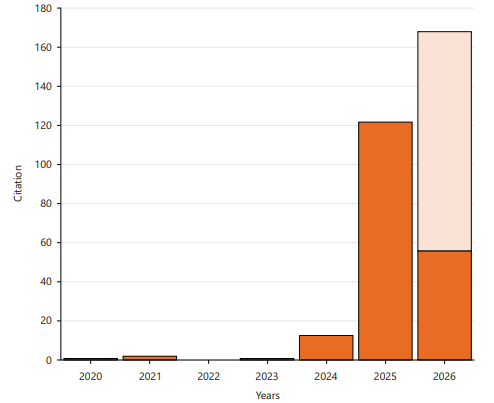
In total, 196 hallucinated references could be drawn on for the present analysis (Fig. 1). Setting aside three references with falsified publication dates of 2020 and 2021, the first hallucinated version of the Williamson & Piattoeva reference was published on the Zenodo platform on 28 June 202322. The proportion of hallucinated references generated in 2024 was still small (13 citations), quickly rising to 122 citations in 2025. At the time of writing (end of April 2026), 56 hallucinated references are on record. When extrapolating this for the entire year, we can anticipate 170 references for 2026.
|
| Table 3: | Publication type by gender of lead author and year of publication. (For the ranking scale, see Table 2) | |||
| Gender (%) | Year of publication | ||||||||
| Publication type | ♀ | ♂ | 2020 | 2021 | 2023 | 2024 | 2025 | 2026 | n |
| Book | 60 | 40 | 6 | 1 | 7 | ||||
| Book chapter | 50 | 50 | 22 | 15 | 37 | ||||
| Conference Paper | 73.3 | 26.7 | 1 | 15 | 16 | ||||
| Journal, SCImago Q1 | - | 100 | 1 | 1 | |||||
| Journal, SCImago Q2 | - | 100 | 2 | 1 | 3 | ||||
| Journal, SCImago Q3 | 25 | 75 | 2 | 2 | 4 | ||||
| Journal, unranked | 54.8 | 45.2 | 1 | 2 | 5 | 23 | 11 | 42 | |
| Journal, predatory | 47.8 | 52.2 | 1 | 7 | 49 | 18 | 75 | ||
| Thesis | 100 | - | 4 | 4 | |||||
| Genuine non-journal | 57.1 | 42.9 | 4 | 3 | 7 | ||||
| Total | 97 | 89 | 1 | 2 | 1 | 13 | 123 | 56 | 196 |
As shown in Table 3, a total of 196 publications were analyzed. Predatory journals accounted for the largest proportion of publications (n = 75), followed by unranked journals (n = 42) and book chapters (n = 37). Conference papers represented 16 publications, whereas books, genuine non-journal publications, theses, and SCImago-ranked journals (Q1-Q3) were comparatively fewer. Most publications were produced during 2025 (n = 123), followed by 2026 (n = 56), while only a small number were published between 2020 and 2024. Regarding the gender of the lead author, female authors were more represented in conference papers (73.3%), books (60.0%), genuine non-journal publications (57.1%), unranked journals (54.8%), and theses (100%). Male lead authors predominated in SCImago-ranked journals, accounting for 100% of Q1 and Q2 publications and 75.0% of Q3 publications, while predatory journal publications showed a nearly balanced distribution between female (47.8%) and male (52.2%) lead authors.
| Table 4: | Journal type by gender and science rank of lead author | |||
| Gender (%) | Quintile (%) | ||||||||
| Journal type | ♀ | ♂ | 1 | 2 | 3 | 4 | 5 | Avg±Std | n |
| Ranked | 22.2 | 77.8 | 37.5 | 37.5 | 25 | - | - | 1.78±0.83 | 9 |
| Unranked | 53.7 | 46.3 | 59.5 | 31 | 7.1 | 2.4 | - | 1.54±0.74 | 42 |
| Predatory | 44 | 56 | 60 | 28 | 10.7 | - | 1.3 | 1.55±0.79 | 75 |
| Table 5: | Gender of lead author by science rank of lead author | |||
| Quintile (%) | ||||||
| Journal type | 1 | 2 | 3 | 4 | 5 | n |
| Female | 66 | 21.6 | 10.3 | 1 | 1 | 97 |
| Male | 56.2 | 34.8 | 6.7 | 2.2 | - | 89 |
| Organisation | 100 | - | - | - | - | 2 |
| n.d. | 62.5 | 37.5 | - | - | - | 8 |
As presented in Table 4, predatory journals constituted the largest group (n = 75), followed by unranked journals (n = 42) and ranked journals (n = 9). Male lead authors predominated in ranked journals (77.8%), whereas female lead authors were slightly more represented in unranked journals (53.7%). Predatory journals showed a relatively balanced gender distribution, with 44.0% female and 56.0% male lead authors. Across all journal types, publications were concentrated in Quintile 1, accounting for 37.5% of ranked journals, 59.5% of unranked journals, and 60.0% of predatory journals. The mean science rank was comparable among journal types, with average scores of 1.78±0.83 for ranked journals, 1.54±0.74 for unranked journals, and 1.55±0.79 for predatory journals.
Table 5 shows the distribution of the science rank of lead authors by gender. Among female lead authors (n = 97), 66.0s% were classified in Quintile 1, followed by 21.6% in Quintile 2, 10.3% in Quintile 3, and 1.0% each in Quintiles 4 and 5. Among male lead authors (n = 89), 56.2% were in Quintile 1, 34.8% in Quintile 2, 6.7% in Quintile 3, and 2.2% in Quintile 4, with no male lead authors in Quintile 5. Publications led by organizations (n = 2) were exclusively classified in Quintile 1, while those with no identified lead author (n.d.; n = 8) were distributed between Quintile 1 (62.5%) and Quintile 2 (37.5%).
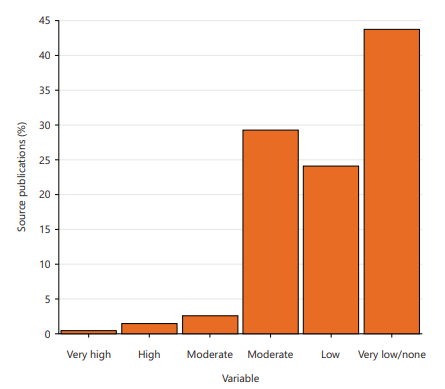
When considering the publication quality of the sources, two-thirds of the source documents (66.3%) were published in publications of low and very low quality, with another 29.1% of source documents as variable moderate quality. Only 2% of source publications can be regarded as being of high or very high quality (Fig. 2).
As shown in Table 6, very low or no publication quality was the most common category (n = 117), followed by low-quality (n = 50) and moderate (variable) publications (n = 21). Across all publication quality categories, Quintile 1 lead authors accounted for the largest proportion, while Quintiles 4 and 5 were minimally represented. High- and very high-quality publications were uncommon, with only 3 and 1 publications, respectively.
As presented in Table 7, Southern Asia contributed the highest number of publications (n = 51), followed by South-eastern Asia (n = 32) and Latin America/Caribbean (n = 23). Most very high-quality and high-quality publications originated from South-eastern Asia, whereas very low-quality publications were predominantly from Southern Asia. Low- and moderate-quality publications were distributed across multiple regions, with notable contributions from South-Eastern Asia, Southern Asia, Western Europe, and Latin America/Caribbean.
|
| Table 6: | Publication quality by science rank of lead author | |||
| Quintile (%) | ||||||
| Journal type | 1 | 2 | 3 | 4 | 5 | n |
| Very high | - | 100 | - | - | - | 1 |
| High | 33.3 | 66.7 | - | - | - | 3 |
| Moderate | 50 | - | 50 | - | - | 4 |
| Moderate (variable) | 25.9 | 8.6 | 1.7 | - | - | 21 |
| Low | 68.8 | 27.1 | 4.2 | 4.2 | - | 50 |
| Very low/none | 59.8 | 29.1 | 9.4 | 0.9 | 0.9 | 117 |
| Table 7: | Geographic distribution of publication quality (n = 196) | |||
| Europe | VH | H | MO | MV | L | VL | N |
| Northern Europe | - | - | 20 | - | - | 3.7 | 4 |
| Eastern Europe | - | - | - | 5.3 | 2.1 | 1.2 | 5 |
| Southern Europe | - | - | - | 14 | 4.2 | 2.4 | 12 |
| Western Europe | - | - | - | 1.8 | 14.6 | 0 | 8 |
| Americas | |||||||
| Northern America | - | - | - | 5.3 | 8.3 | 4.9 | 11 |
| Latin America/Caribbean | - | 33.3 | - | 15.8 | 18.8 | 4.9 | 23 |
| Africa | |||||||
| Northern Africa | - | - | - | 3.5 | - | 1.2 | 3 |
| Sub-Saharan Africa | - | - | - | 10.5 | 2.1 | 8.5 | 14 |
| Asia | |||||||
| Western Asia | - | - | 20 | 12.3 | 8.3 | 1.2 | 13 |
| Central Asia | - | - | 20 | 5.3 | 2.1 | 6.1 | 10 |
| Eastern Asia | - | - | - | 1.8 | - | 3.7 | 4 |
| South-Eastern Asia | 100 | 66.7 | 20 | 14 | 14.6 | 15.9 | 32 |
| Southern Asia | - | - | 20 | 10.5 | 22.9 | 40.2 | 51 |
| Oceania | |||||||
| Australia and New Zealand | - | - | - | - | 2.1 | 3.7 | 4 |
| Melanesia | - | - | - | - | - | 2.4 | 2 |
| H: High, L: Low, MO: Moderate, MV: Moderate (variable), VH: Very high, VL: Very low and see Table 9 for individual country breakdown | |||||||
|
| Table 8: | Publication quality by OECD household disposable income quintile of lead author | |||
| Q5 | Q4 | Q3 | Q2 | Q1 | |
| Very high | - | - | - | - | 1.0 |
| High | - | - | 3.6 | 2.8 | 1.0 |
| Moderate | 4.3 | 7.7 | 3.6 | 2.8 | 0.0 |
| Moderate (variable) | 17.4 | 53.8 | 50.0 | 27.8 | 24.0 |
| Low | 34.8 | 38.5 | 10.7 | 30.6 | 21.9 |
| Very low/none | 43.5 | - | 32.1 | 36.1 | 52.1 |
| n | 23 | 13 | 28 | 36 | 96 |
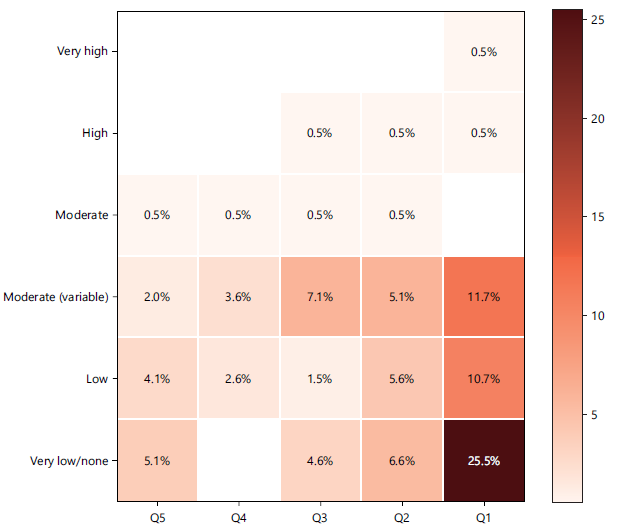
Cross-referencing the publication quality of the source documents with the OECD household disposable income quintile of the country30 of the lead author shows a clear correlation. Authors residing in low-income countries (Q1) tend to publish in very low-quality journals. The Q5 × ‘very low/none’ association was significant by Fisher’s Exact Test (OR = 2.31, p = 0.0058). At the same time, authors with high and very high-quality publications in OECD Q4 and Q5 countries are not represented among such source publications (Fig. 3).
As shown in Table 8, very low or no publication quality was the most common category across all OECD household disposable income quintiles, particularly in Q1 (52.1%). Moderate (variable) publications were also common, accounting for 53.8% in Q4 and 50.0% in Q3. Low-quality publications were most frequent in Q4 (38.5%) and Q5 (34.8%), whereas very high-quality publications were observed only in Q1 (1.0%).
| Table 9: | Frequency of countries (for ranking scale of tiers see Table 2) | |||
| Country | n | Tier | Country | n | Tier | Country | n | Tier |
| Algeria | 1 | 5 | France | 4 | 1 | Philippines | 5 | 4 |
| Argentina | 1 | 4 | Germany | 3 | 1 | Portugal | 1 | 2 |
| Armenia | 1 | 5 | Greece | 4 | 2 | Saudi Arabia | 1 | 3 |
| Australia | 4 | 1 | India | 44 | 3 | Sierra Leone | 1 | n.r. |
| Azerbaijan | 2 | 5 | Indonesia | 18 | 4 | Slovakia | 1 | 3 |
| Bahrain | 1 | 5 | Iran | 1 | 3 | Spain | 2 | 2 |
| Belgium | 1 | 2 | Italy | 4 | 2 | Thailand | 1 | 4 |
| Benin | 1 | n.r. | Kazakhstan | 3 | 4 | Türkiye | 5 | 3 |
| Brazil | 6 | 3 | Lebanon | 3 | 5 | Turkmenistan | 1 | n.r. |
| Bulgaria | 3 | 5 | Libya | 1 | 5 | Ukraine | 1 | 4 |
| Canada | 1 | 2 | Malaysia | 6 | 3 | United Kingdom | 4 | 1 |
| Chile | 2 | 3 | Mexico | 6 | 3 | United States | 10 | 1 |
| China | 4 | 2 | Morocco | 1 | 4 | Uzbekistan | 6 | 5 |
| Colombia | 2 | 4 | Nigeria | 11 | 4 | Vietnam | 2 | 4 |
| Ecuador | 5 | 5 | North-Macedonia | 1 | 5 | |||
| Eswatini | 1 | n.r. | Pakistan | 6 | 4 | |||
| Fiji | 2 | n.r. | Peru | 1 | 4 | Total | 196 | |
| N: Number of observations/articles/authors (as applicable), Tier: Classification category of the respective country and n.r.: Not reported | ||||||||
The author is conscious that there may well be structural issues that explain why the authors of the source papers may have chosen to rely on generative AI tools to support their writing, such as the “publish or perish” culture as well as a lack of AI literacy.
The institutional culture of “publish or perish”, which is pervasive in many, especially smaller institutions, rewards volume over quality, with citation rates and ‘impact’ being additional critical metrics. This culture incentivizes researchers, in particular early-career researchers on contracts, to seek rapid publication31-33. Publication in open access journals has been shown to result both in higher citation rates34,35 and in increased attention in news stories and social media36,37. At the same time, review processes in journals by leading publishers are increasingly slow and protracted, and the cost of open access publishing in their journals is prohibitive for scholars whose academic institutions do not have the financial wherewithal to pay the article processing charge38. Structural pressures on emerging academics are particularly strong in countries such as India, Indonesia and Nigeria32,33-39, which is also reflected in the data compiled for this paper (Table 9). It is in that space that unranked and, in particular, predatory journals and paper mills flourish. A critical characteristic of unranked and predatory journals is that peer review is weak or, in the case of predatory journals, almost absent40.
Just as the advent of generative AI has provided students with the opportunity to rapidly generate seemingly convincing, albeit generic or flawed, essays2, it has also offered researchers the prospect of generating a seemingly convincing academic paper. Given the current difficulty with tools that can reliably distinguish between human and genAI-written text, convincingly sounding papers will pass cursory editorial scrutiny. Taken together, it is not surprising that publication in less rigorously reviewed conference volumes or book chapters, as well as in journals that promise rapid publication at a reasonable cost and that appear to exercise limited scrutiny of an author’s work, is seen as an opportunity for career advancement. This is well reflected in the data, where 66.2% of source documents were published in publications of low and very low quality (Table 6) and where, overall, 49% of all authors reside in counties that belong to the lowest quintile of OECD household disposable income30. The association between publication quality and disposable income is very strong (Fig. 3).
There is an abundance of literature related to academic integrity and the use of generative AI41-43. The above use of generative AI in text generation implies intent by the authors to use generative AI to knowingly engage in academic misconduct by submitting fraudulently created manuscripts17. This need not necessarily be the case, as a lack of AI literacy may well have resulted in unwarranted faith being placed in an output that was deemed to be genuine and trustworthy, or that a journal’s publication guidelines were not as explicit as desirable44. Academic integrity nonetheless requires that authors verify their sources and, where they cannot, either to refrain from citing them or to cite them with the appropriate caveats of ‘not seen’ or ‘cited after’17.
There is a small group of source documents, however, where the undeclared use of generative AI in manuscript preparation is quite problematic, as these papers focus on issues of ethics and plagiarism. To avoid generating citations for these, they will be referred to by their serial number in the dataset (nºs 2, 3, 43, 151, 186 and 190)21. Four of these source documents were published in predatory journals (2, 3, 43, 190), one was a PhD thesis in education (180), and one was a paper in a SCImago Q3 journal (186). It is quite ironic that one of the papers notes that “hidden use of tools like ChatGPT compromises the reliability of assessments and threatens fundamental academic ethics” (190). What is even more ironic in that circumstance is that the authors’ institution, Atlantic International University (AIU) in Honolulu, has been described as a degree mill. AIU is not an education provider accredited by an accrediting agency recognized by the U.S. Department of Education, with several US states prohibiting the use of their degrees for employment and/or academic credit (as AIU does not operate under National Council for State Authorization Reciprocity Agreements standards)45.
The key findings of the paper are that the ease with which generative AI allows the generation of plausible text provides a tempting ‘solution’ in the context of “publish or perish” pressures. Career pressure, slow reputable journals, high open-access fees, and low AI literacy may contribute to pushing authors towards rapid publication options with weak review systems where hallucinated citations are less likely to be caught. This has two main implications, one for the authors and one for the publication outlets.
Even if authors did not intend misconduct, they remain responsible for checking whether cited sources actually exist. Clearly, evidence of undeclared use of generative AI will harm the author’s academic reputation and, ultimately, career progression. Even where generative AI-written text may not be detectable, hallucinated citations will be a tell-tale of generative AI use.
The other implication is for the editors or publishers of journals and books. While editors and publishers of predatory journals may not care about reputational implications, editors of genuine but unranked journals may wish to take heed. Articles that contain evidence of undeclared use of generative AI, let alone hallucinated references, will cause reputational damage as they signal weak review systems. Moreover, as existing publications are in effect a permanent record of this, reputational damage may persist unless the papers are retracted.
The limitations of the paper are that it relies on a single hallucinated citation cluster in a single discipline. While this can be seen as a microcosm, it may make it difficult to generalize its findings to all AI-generated citation errors or to academic publishing as a whole. It also infers probable use or misuse of generative AI from publication patterns and citation behavior without direct evidence that the authors intentionally used AI tools or failed to verify sources. Future work should test whether similar hallucinated citation clusters appear across other disciplines. In a separate line of work, the robustness of the Global Research Quality Index employed in this paper could be tested by altering the allocated weights.
CONCLUSION
This study highlights the presence and distribution of AI-generated hallucinated citations across different publication types, journal qualities, and geographic contexts. The findings demonstrate that such publications are disproportionately concentrated in low-quality and predatory journals, with a notable representation from authors in lower-income research systems. Overall, the results indicate that generative AI may reinforce existing structural inequalities in scholarly publishing while exposing weaknesses in editorial oversight and peer review systems. These outcomes underscore the need for stronger governance mechanisms, improved AI literacy among researchers, and enhanced editorial screening to safeguard research integrity in the era of generative AI.
SIGNIFICANCE STATEMENT
Researchers are increasingly finding fake references, created by generative Artificial Intelligence (AI), in academic papers. This study examined 196 publications that cited a made-up source called “Education Governance and Datafication” to understand where these false citations appear and why. The study found that fake citations are most common in low-quality or predatory journals that have weak or no peer review. They were also more common among authors working in lower-income countries and under-resourced research systems. The paper argues that pressure to publish, expensive publication fees, slow review processes, and limited understanding of AI tools encourage some researchers to rely on generative AI. The findings suggest that AI can exacerbate existing inequalities in global academic publishing and reveal serious weaknesses in journal editing and quality-control systems, allowing inaccurate information to spread through the scientific literature.
REFERENCES
- Spennemann, D.H.R., 2025. Generative artificial intelligence and the future of public knowledge. Knowledge, 5.
- Spennemann, D.H.R., 2023. ChatGPT and the generation of digitally born “knowledge”: How does a generative AI language model interpret cultural heritage values? Knowledge, 3: 480-512.
- Haupt, M.R., L. Yang, T. Purnat and T. Mackey, 2024. Evaluating the influence of role-playing prompts on ChatGPT’s misinformation detection accuracy: Quantitative study. JMIR Infodemiol., 4.
- Zielinski, C., M.A. Winker, R. Aggarwal, L.E. Ferris and M. Heinemann et al., 2023. Chatbots, generative AI, and scholarly manuscripts: WAME recommendations on chatbots and generative artificial intelligence in relation to scholarly publications. Colombia Med., 54.
- Flanagin, A., K. Bibbins-Domingo, M. Berkwits and S.L. Christiansen, 2023. Nonhuman “authors” and implications for the integrity of scientific publication and medical knowledge. JAMA, 329: 637-639.
- Morari, V., D. Grimes and D. Hawe, 2026. Academic integrity and generative artificial intelligence-views and perceptions of students in an Irish University. J. Acad. Ethics, 24.
- Lancaster, T., M. Draper, S. Dann, R. Crockett and M. Draper, 2025. Developing policies to address historic contract cheating and misuse of generative artificial intelligence. J. Acad. Writ., 15.
- Zhang, L., C. Amos and I. Pentina, 2025. Interplay of rationality and morality in using ChatGPT for academic misconduct. Behav. Inf. Technol., 44: 491-507.
- Yao, M., Y. Wei and H. Liu, 2026. AI practices and ethical concerns: An analysis of undeclared uses of AI in published research articles. Ethics Behav., 36: 312-324.
- Burleigh, C. and A.M. Wilson, 2024. Generative AI: Is authentic qualitative research data collection possible? J. Educ. Technol. Syst., 53: 89-115.
- Kousha, K. and M. Thelwall, 2024. Artificial intelligence to support publishing and peer review: A summary and review. Learned Publ., 37: 4-12.
- Guo, Z., H. Mao and F. Zhang, 2026. The attention mismatch: Mapping the structural academic governance deficit in the age of generative AI. Publications, 14.
- Chin, J.M. and R. McWhirter, 2026. New evidence of weakness and inconsistency in the regulation of research misconduct in Australia. Account. Res., 33.
- Kendall, G. and J.A.T. da Silva, 2024. Risks of abuse of large language models, like ChatGPT, in scientific publishing: Authorship, predatory publishing, and paper mills. Learned Publ., 37: 55-62.
- Spennemann, D.H.R., 2025. The origins and veracity of references ‘cited’ by generative artificial intelligence applications: Implications for the quality of responses. Publications, 13.
- Chelli, M., J. Descamps, V. Lavoué, C. Trojani and M. Azar et al., 2024. Hallucination rates and reference accuracy of ChatGPT and Bard for systematic reviews: Comparative analysis. J. Med. Internet Res., 26.
- Resnik, D.B. and M. Hosseini, 2026. Hallucinated citations produced by generative artificial intelligence may constitute research misconduct when citations function as data in scholarly papers. Account. Res.
- Sakai, Y., H. Kamigaito and T. Watanabe, 2026. Hallucitation matters: Revealing the impact of hallucinated references with 300 hallucinated papers in ACL conferences. arXiv.
- Goldman, S., 2026. NeurIPS, one of the world’s top academic AI conferences, accepted research papers with 100+ AI-hallucinated citations, new report claims. Fortune.
- Spennemann, D.H.R., 2026. How unique are hallucinated citations offered by generative artificial intelligence models? Publications, 14.
- Spennemann, D., 2026. Education governance and datafication a data set of references hallucinated by generative. Charles Sturt Univ.
- Alkaissi, H. and S.I. McFarlane, 2023. Artificial hallucinations in ChatGPT: Implications in scientific writing. Cureus, 15.
- Bornmann, L., M. Stefaner, F. de Moya Anegón and R. Mutz, 2014. What is the effect of country-specific characteristics on the research performance of scientific institutions? Using multi-level statistical models to rank and map universities and research-focused institutions worldwide. J. Informetrics, 8: 581-593.
- Pontika, N., T. Klebel, A. Correia, H. Metzler, P. Knoth and T. Ross-Hellauer, 2022. Indicators of research quality, quantity, openness, and responsibility in institutional review, promotion, and tenure policies across seven countries. Quant. Sci. Stud., 3: 888-911.
- van de Laar, L., T. de Kruif, L. Waltman, I. Meijer, A. Gupta and N. Hagenaars, 2018. Improving the evaluation of worldwide biomedical research output: Classification method and standardised bibliometric indicators by disease. BMJ Open, 8.
- Maral, M., 2024. Research performance of higher education in OECD countries: A hybrid multi-criteria decision-making approach. Sage Open, 14.
- Gómez-Núñez, A.J., B. Vargas-Quesada and F. de Moya-Anegón, 2016. Updating the SCImago journal and country rank classification: A new approach using Ward's clustering and alternative combination of citation measures. J. Assoc. Inf. Sci. Technol., 67: 178-190.
- Ayan, D.E., L.L. Haak and D.K. Ginther, 2023. How many people in the world do research and development? Global Policy, 14: 270-287.
- Falagas, M.E., V.D. Kouranos, R. Arencibia-Jorge and D.E. Karageorgopoulos, 2008. Comparison of SCImago journal rank indicator with journal impact factor. FASEB J., 22: 2623-2628.
- Lamarche, P., F. Oehler and I. Rioboo, 2020. European household’s income, consumption and wealth. Stat. J. IAOS, 36: 1175-1188.
- Brewer, C.D., 2026. Publish or perish in the era of ChatGPT. J. Ethics Emerging Technol., 36.
- Adegbilero-Iwari, I., O. Olajide, N.A. Emezie, S.A. Salau and J.K. Fasae et al., 2026. Publish or perish: Scholars’ awareness and perception of scopus-indexed journals as a requirement for career advancement in Nigerian Universities. Open Inf. Sci., 10.
- Sharma, A., S. Dash, V. Pawar and A. Vhatkar, 2023. The Indian struggle against predatory journals: The importance of quality control. J. Pharm. Negat. Results, 14: 556-560.
- Momeni, F., S. Dietze, P. Mayr, K. Biesenbender and I. Peters, 2023. Which factors are associated with Open Access publishing? A Springer Nature case study. Quant. Sci. Stud., 4: 353-371.
- Wassef, D.W., G.L. Barinsky, S. Behbahani, S. Peddireddy and J.G. Grube et al., 2022. The relationship between Open Access article publishing and short-term citations in Otolaryngology. Ann. Otology Rhinology Laryngology, 131: 704-708.
- Lynch, C.P., E.D.K. Cha, M.R. Patel, K.C. Jacob and M.C. Prabhu et al., 2022. How does open access publication impact readership and citation rates of lumbar spine literature? Clin. Spine Surg., 35: E558-E565.
- Vadhera, A.S., J.S. Lee, I.L. Veloso, Z.A. Khan and N.A. Trasolini et al., 2022. Open Access articles garner increased social media attention and citation rates compared with subscription access research articles: An altmetrics-based analysis. Am. J. Sports Med., 50: 3690-3697.
- Borrego, Á., 2023. Article processing charges for open access journal publishing: A review. Learned Publ., 36: 359-378.
- Purnama, A., S. Riyanto, I. Siswanti and L.C. Nawangsari, 2024. Fighting predatory journals: A strategic solution for the quality and sustainability of scientific publications in Indonesia. Social Econ. Bull., 1: 223-240.
- Oermann, M.H., L.H. Nicoll, P.L. Chinn, K.S. Ashton and J.L. Conklin et al., 2018. Quality of articles published in predatory nursing journals. Nurs. Outlook, 66: 4-10.
- Pereira, R., I.W. Reis, V. Ulbricht and N. dos Santos, 2024. Generative artificial intelligence and academic writing: An analysis of the perceptions of researchers in training. Manage. Res. J. Iberoamerican Acad. Manage., 22: 429-450.
- van Niekerk, J., P.M.J. Delport and I. Sutherland, 2025. Addressing the use of generative AI in academic writing. Comput. Educ.: Artif. Intell., 8.
- Shaw, D., 2025. The digital erosion of intellectual integrity: Why misuse of generative AI is worse than plagiarism. AI Soc., 40: 5819-5821.
- Albertyn, R., 2026. Issues of authorship threatening research integrity: Pointers for ethical publication practices. S. Afr. J. Higher Educ., 39: 45-60.
- Onwuameze, N., 2017. State authorization reciprocity agreement: Participation and access to higher education. Open Learn.: J. Open Distance e-Learn., 32: 137-146.
How to Cite this paper?
APA-7 Style
Spennemann, D. H. R. (2026). Prevalence of AI-hallucinated citations in relation to geographical inequalities and publication imperatives. Trends in Scholarly Publishing, 5(1), 156–167. https://doi.org/10.21124/tsp.2026.156.167
ACS Style
Spennemann, D. H. R. Prevalence of AI-Hallucinated Citations in Relation to Geographical Inequalities and Publication Imperatives. Trends Schol. Pub 2026, 5 (1), 156–167. https://doi.org/10.21124/tsp.2026.156.167
AMA Style
Spennemann DHR. Prevalence of AI-hallucinated citations in relation to geographical inequalities and publication imperatives. Trends in Scholarly Publishing. 2026;5(1):156–167. doi:10.21124/tsp.2026.156.167
Chicago/Turabian Style
Spennemann, Dirk H.R. 2026. “Prevalence of AI-Hallucinated Citations in Relation to Geographical Inequalities and Publication Imperatives.” Trends in Scholarly Publishing 5 (1): 156–167. https://doi.org/10.21124/tsp.2026.156.167

This work is licensed under a Creative Commons Attribution 4.0 International License.