
Open Access in Nigeria: Drivers, Barriers, and Policy Recommendations
-
John Stephen Kayode


Department of Physics, Federal University Lokoja, Kogi, Nigeria
| Received 26 Mar, 2026 |
Accepted 23 Jun, 2026 |
Published 30 Jul, 2026 |
Open access (OA), represents a transformative movement in scholarly communication aimed at providing free, immediate, and unrestricted access to academic research outputs. In Nigeria, OA has gained increasing attention as a mechanism for democratizing knowledge, enhancing research visibility, and addressing inequalities in access to scholarly resources. This paper provides a critical policy-oriented analysis of OA realities in Nigeria, drawing on secondary data, institutional reports, and selected case studies based on insights from Nigerian universities. While notable progress has been made, such as the establishment of institutional repositories and growing awareness among librarians and researchers, significant challenges persist, including limited digital infrastructures, inconsistent institutional policies, inadequate funding, and cultural barriers within academia. Additionally, concerns regarding predatory publishing and Article Processing Charges (APCs), complicate adoption. The study contributes to the literature by synthesizing existing evidence with contextual policy evaluation and illustrative institutional case observations, offering actionable recommendations for strengthening Nigeria’s OA ecosystem. By aligning national policy, improving digital infrastructure, and incentivizing researchers, Nigeria can harness OA as a strategic tool for academic advancement and socio-economic development.
| Copyright © 2026 John Stephen Kayode. This is an open-access article distributed under the Creative Commons Attribution License, which permits unrestricted use, distribution, and reproduction in any medium, provided the original work is properly cited. |
INTRODUCTION
Open access (OA), refers to the free availability of scholarly literature on the public internet, permitting users to read, download, copy, distribute, and use research outputs without financial, legal, or technical barriers (Budapest OA Initiative)1-3. Globally, OA has become central to discussions about equity in knowledge production and dissemination. In developing countries such as Nigeria, OA holds particular promise in addressing structural limitations in research funding, subscription access, and international visibility.
Nigeria, with one of the largest higher education systems in Africa, produces substantial scholarly output across disciplines. However, limited funding for journal subscriptions and inadequate research infrastructure have historically restricted access to current academic literature4. Consequently, OA presents an opportunity to expand access to knowledge, improve research impact, and align Nigerian scholarship with global academic standards. Despite global studies, there is limited analysis of OA implementation, challenges, and innovations specific to Nigeria. The country can still harness OA as a strategic tool for academic advancement and socio-economic development. This study aims to critically assess the drivers, barriers, and policy landscape of Open Access in Nigeria, in order to develop practical and evidence-based recommendations for improving its adoption and sustainability.
LANDSCAPE OF OPEN ACCESS IN NIGERIA
Growth in awareness and institutional adoption: Awareness of OA in Nigeria has steadily increased over the past decade, particularly among academic librarians and research administrators. Many universities have established institutional repositories (IRs) to archive theses, dissertations, and faculty publications5,6. These repositories often utilize open-source platforms such as DSpace or EPrints, enabling long-term digital preservation and global discoverability.
Despite these developments, repository implementation remains inconsistent. Some repositories are under-populated due to limited deposit mandates and insufficient awareness among faculty members7,8. In many institutions, participation remains voluntary, reducing overall impact.
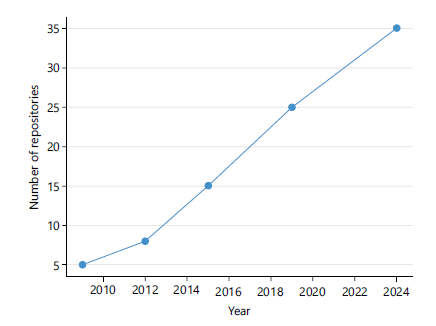
Early studies indicate that between 2009 and 2019, approximately 25 OA institutional repositories were established in Nigerian universities, collectively hosting over 68,000 scholarly items8-11, including theses, dissertations, and journal articles. More recent analyses suggest continued growth, with about 35 repositories identified in Nigeria as of 2024, the majority of which are hosted by universities, alongside a few managed by national institutions such as the Central Bank and the National Library.
Despite this increase, repository penetration remains limited relative to the size of Nigeria’s higher education system. Survey-based evidence indicates that only a fraction of universities, around 21 institutions, have fully operational repositories, and even among these, functionality and policy implementation vary considerably. Earlier global registry data also showed that Nigeria had as few as 14 internationally visible repositories at one point, highlighting persistent visibility and indexing challenges12-15.
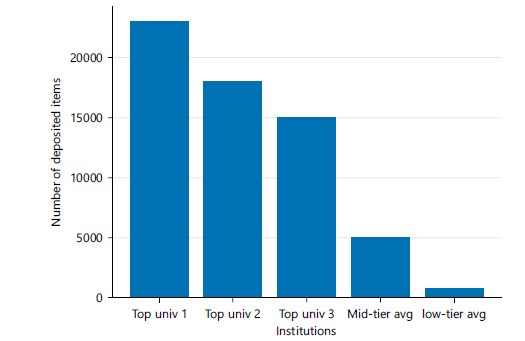
In terms of content growth, repository deposits have expanded but remain unevenly distributed. Some institutions account for a disproportionately large share of uploads-for example, a single university repository contributed over 23,000 items within the national total14. This suggests that while awareness is increasing, active participation and consistent content deposition are still concentrated in a limited number of institutions.
Overall, these statistics demonstrate a clear upward trend in OA adoption in Nigeria (Fig. 1). However, they also reveal structural gaps in repository coverage, standardization, and utilization. The growth in awareness has not yet fully translated into widespread institutionalization, indicating the need for stronger policies, incentives, and infrastructure to support sustained adoption14,15.
The trend description showed that: Slow growth phase was recorded between the years 2009 to 2014 for fewer than 10 repositories. Moderate expansion was recorded from 2015 to 2019, with the number of repositories increasing to ~25. On the other hand, gradual growth was recorded from 2020 and 2024 with a rise to about ~35 repositories.
The growth curve demonstrates a non-linear adoption pattern, with acceleration occurring after increased global advocacy for OA and the introduction of repository technologies. However, the post-2020 plateauing trend suggests structural constraints that limit rapid expansion.
|
|
The distribution of deposited items across Nigerian Repositories, as presented in Fig. 214,15, gives trend descriptions as; The top 3 Nigerian Institutions produced about 15,000 to 23,000 items each. The mid-tier institutions give records of 2,000 to 8,000 items. While low-tier institutions produce fewer than 1,000 items, as presented in the figure.
This distribution highlights institutional inequality in research dissemination capacity. Factors contributing to this disparity include:
| • | Availability of repository policies | |
| • | Institutional funding and ICT infrastructures | |
| • | Level of librarian and faculty engagement |
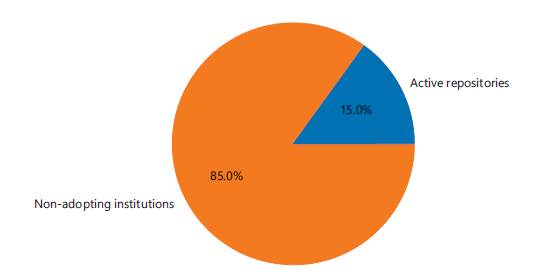
A pie chart that describes the repository adoption against the total universities in Nigeria is as presented in Fig. 314,15. The chart underscores the limited penetration of OA systems, despite increasing awareness. This gap suggests that policy enforcement and incentives are critical missing links in Nigeria’s OA ecosystem. Two segments, e.g., (a) Active repositories of approximately 15%, and (b) Non-adopting institutions that accounted for the remaining 85% approximately, as presented.
|
Comparative insight: Nigeria in the African context: When compared to leading African countries such as South Africa and Kenya, Nigeria lags in both repository density and content volume per institution. South Africa, for example, has near-universal repository adoption among its major universities, supported by strong national policies and funding frameworks. The implications of this on Nigeria’s OA growth are institution-driven rather than policy-driven, limiting scalability and national coherence.
The empirical analysis carried out revealed four major patterns, as shown in Fig. 1-3, that includes: (i) Steady but slow growth in repository numbers over time, (ii) Low national coverage, with adoption limited to a minority of institutions, (iii) Highly unequal content distribution, favoring well-resourced universities, and (iv) Weak policy enforcement, contributing to inconsistent participation.
The data suggest that Nigeria’s OA ecosystem is currently in a fragmented expansion phase, characterized by isolated successes rather than coordinated national progress. While awareness campaigns and institutional initiatives have driven initial adoption, systemic barriers-particularly infrastructure, funding, and policy gaps-continue to constrain scalability. Therefore, to transition from growth to maturity, Nigeria must shift from voluntary adoption models to structured, policy-backed implementation frameworks.
Comparative analysis: Nigeria, South Africa, and Kenya: A comparative assessment of OA repository development across Africa reveals significant disparities between Nigeria and leading countries such as South Africa and Kenya. These differences are evident in both the number of repositories and the volume of deposited research outputs, reflecting variations in policy frameworks, infrastructure, and institutional commitment.
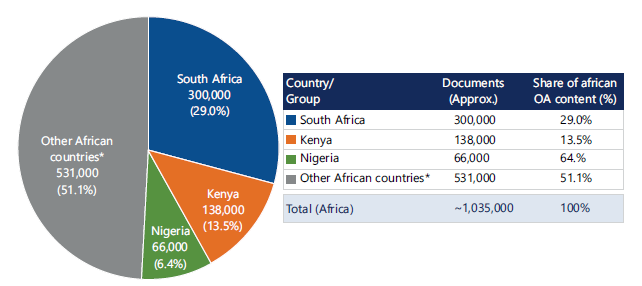
Repository numbers and continental rankings, as shown by the evidence from the Directory of OA Repositories (OpenDOAR), show that South Africa leads other African countries with approximately 33-51 repositories, followed by Kenya with about 28 repositories, while Nigeria ranks third with approximately 21 repositories. Citations. Earlier, and complementary studies similarly confirm that South Africa consistently occupies the top position in Africa’s OA ecosystem, with strong institutional participation and national-level policy support. Kenya has emerged as a close competitor, particularly in East Africa, due to coordinated national initiatives and external support programs. Citations. Nigeria’s position as third in Africa indicates moderate progress, but also highlights a significant gap between Nigeria and leading OA nations, especially considering Nigeria’s larger university system, as shown in Fig. 416,17. The disparity becomes more pronounced when examining repository content, as shown in the African repository data presented in Fig. 4.
|
| Table 1: | Open access repository metrics in Africa16,17 | |||
| Indicator | South Africa | Kenya | Nigeria |
| Number of repositories | ~33-51 | ~28 | ~21 |
| Estimated documents | ~300,000+ | ~138,000+ | ~66,000+ |
| Institutional adoption | Near-universal | High (60+universities) | Moderate (limited institutions) |
| Policy framework | Strong national policies | Coordinated national initiatives | Weak/fragmented |
| Global visibility | High | High and growing | Moderate |
This shows that although Nigeria has a relatively comparable number of repositories, its content volume is significantly lower, indicating weaker repository utilization and lower deposit rates. Repository quantity does not translate into productivity-Nigeria’s challenge lies more in content population and sustained engagement than in repository establishment alone.
Kenya’s success reflects coordinated national programs and strong institutional networks, while South Africa benefits from policy-driven implementation and sustained investment. Nigeria, by comparison, remains largely institution-driven without a unified national framework.
Across Africa, only about 24 countries host repositories, accounting for roughly 259 repositories out of nearly 6,000 globally, highlighting the continent’s limited participation in global scholarly communication. Within this constrained ecosystem, a small number of countries-primarily South Africa, Kenya, and Nigeria-dominate16,17.
However, even within this leading group, internal inequalities persist as presented in Table 1. Where: South Africa showed high repository density and high output. Kenya showed high institutional participation and rapid growth. Nigeria, on the other hand, showed a moderate repository count but low output efficiency.
The comparative analysis highlights three critical insights:
| • | Policy matters: Countries with national OA mandates, e.g., South Africa, Kenya, outperform those without, e.g., Nigeria | |
| • | Adoption of depths counts more than mere numbers, e.g., Nigeria’s challenge is not just repository creation but active contents deposition and usage | |
| • | Coordination drives success, as shown in the case of Kenya’s model which demonstrates the effectiveness of networked institutional collaboration and external partnerships |
| Table 1: | Using available continental data for South Africa, Kenya, and Nigeria, empirical application16,17 | |||
| Country | Repositories (R) | Deposited items (D) | REI (D/R) |
| South Africa | 45 (avg.) | 300,000 | 6,667 |
| Kenya | 28 | 138,000 | 4,929 |
| Nigeria | 21 | 66,000 | 3,143 |
While Nigeria is among the leading African countries in OA repository development, the country lags behind South Africa and Kenya in repository productivity, policy coherence, and system-wide adoption. Bridging this gap requires a shift from fragmented institutional efforts to coordinated national strategies, supported by infrastructural investment and policy enforcement.
Statistical modeling: Repository efficiency index (REI) in Africa: To move beyond descriptive comparisons, this study introduces a repository efficiency index (REI), to evaluate how effectively countries convert repository infrastructures into accessible scholarly content. The REI provides a normalized measure of repository productivity and enables cross-country comparison as shown in Eq. 118:
Repository efficiency index is defined as:
| (1) |
Where:
Deposited Items (D): Total number of documents hosted in repositories
Repositories (R): Number of active institutional repositories
Hence, Eq. 2 yields:
| (2) |
This model assumes that higher values indicate greater efficiency in repository utilization, reflecting stronger institutional participation, policy enforcement, and digital infrastructure, e.g., Table 2.
The REI reveals clear efficiency differentials across the 3 countries sampled, as presented in Table 2:
| • | South Africa (REI ≈ 6,667): Demonstrates the highest efficiency, indicating strong repository policies, consistent deposit mandates, and robust institutional engagement | |
| • | Kenya (REI ≈ 4,929): Kenya shows relatively high efficiency, reflecting coordinated national initiatives and effective repository networks | |
| • | Nigeria (REI ≈ 3,143): However, the Nigerian REI exhibits significantly lower efficiency, suggesting that while repositories exist, they are underutilized in terms of content population in the country |
Institutional repositories and research visibility: Institutional repositories are central to Nigeria’s OA ecosystem. They enhance visibility by increasing citation potential and ensuring that research outputs are indexed by search engines and academic databases9. For Nigerian scholars, whose work may otherwise be underrepresented in international journals, repositories provide a critical platform for global engagement.
However, repository sustainability depends on adequate staffing, infrastructure, and policy support. Interoperability standards and consistent metadata practices remain areas requiring improvement to ensure integration into global knowledge networks.
Relevance and impact of institutional repositories in Nigeria: Institutional repositories (IRs) play a critical role in advancing OA by enhancing the visibility, accessibility, and long-term preservation of scholarly outputs. In the Nigerian context, where access to subscription-based journals is limited, repositories function as alternative knowledge dissemination channels, enabling both local and global audiences to engage with research outputs without financial barriers. Beyond access, IRs also contribute to research impact, as openly available works are more likely to be discovered, downloaded, and cited19.
Empirical relevance of visibility and citation advantage: Evidence from global OA studies suggests that articles made freely available through repositories can experience a citation advantage ranging between 18% and 50%, depending on discipline and publication model6. While Nigeria-specific citation studies remain limited, emerging institutional analyses indicate similar trends. Repository-hosted theses, dissertations, and preprints often achieve higher download rates and increased international visibility, particularly through indexing by platforms such as Google Scholar, Scopus, Web of Science, DOAJ, etc19.
For instance, repository analytics from several Nigerian universities show that deposited works receive substantial global traffic, with downloads originating from North America, Europe, and Asian regions that may otherwise have limited exposure to locally published African research literature. This demonstrates that IRs serve not only local disseminations but also provide global knowledge integration13-16,18,20.
Nigerian concrete institutional examples: Several Nigerian universities provide practical illustrations of successful repository implementation. Some examples of selected institutions are:
| • | University of Ibadan Institutional Repository (UI IR): One of the earliest and most robust repositories in Nigeria, hosting tens of thousands of items, including theses, dissertations, and faculty publications, is the University of Ibadan repository. The repository has significantly improved the global visibility of UI research, with consistent indexing in major academic search engines | |
| • | Ahmadu Bello University Institutional Repository (ABU Zaria): Known for strong content growth, ABU’s repository contains a wide range of academic materials and has contributed to increasing the dissemination of research in agriculture, engineering, and environmental sciences | |
| • | University of Lagos Repository (UNILAG): UNILAG repository demonstrates steady adoption, particularly in postgraduate research archiving. The repository supports academic visibility and has improved access to locally generated research outputs | |
| • | Federal University of Technology Minna Repository (FUTMinna): Among the generations of the University of Technologies, FUTMinna is a growing repository with increasing deposits, particularly in applied sciences and technology, contributing to regional and international research exposure |
Observed impact across Nigerian repositories: Across these four institutions, several consistent outcomes emerge, such as13-17:
| • | Increased discoverability: Repository contents are indexed by search engines, making Nigerian research more accessible globally | |
| • | Higher download and usage rates: Openly accessible documents often record significantly higher download counts compared to subscription-restricted publications | |
| • | Improved citation potential: Although systematic national data is limited, available evidence suggests that openly accessible works are more likely to be cited, aligning with global OA trends | |
| • | Preservation of indigenous knowledge: Repositories provide a platform for preserving locally relevant research, including studies on Nigerian socio-economic and environmental issues that may not be prioritized in international journals |
Critical gap from visibility to measurable impact: Despite the enumerated benefits, a key limitation remains, i.e., the lack of standardized national metrics for tracking citation impact and repository performance in Nigeria. Most institutions in the country depend on basic download statistics rather than comprehensive bibliometric indicators such as citation counts, altimetry’s, or h-index contributions.
This gap highlights the need for: (i) Integration with global indexing systems (e.g., Scopus, Web of Science), (ii) Adoption of repository analytics tools and (iii) Development of national-level monitoring frameworks.
Institutional repositories in Nigeria clearly demonstrate their relevance as tools for enhancing research visibility and accessibility. Leading universities provide strong examples of successful implementation, with measurable improvements in global reach and usage. However, the transition from visibility gains to quantifiable research impact remains incomplete due to limited data infrastructure and evaluation systems.
Available evidence suggests that Nigerian institutional repositories contribute significantly to global research visibility, though further bibliometric studies are required to quantify citation advantages at the national level.
OPPORTUNITIES AND DRIVERS FOR OPEN ACCESS IN NIGERIA
Reducing cost barriers: Subscription-based journals are often prohibitively expensive for Nigerian universities operating under constrained budgets. As a result, many institutions cannot afford comprehensive journal packages10,11. OA eliminates subscription barriers, allowing students, lecturers, and independent researchers to access scholarly content freely.
Programs such as Research4Life have helped bridge access gaps, but they do not fully substitute for a sustainable, locally driven OA model12. Therefore, OA remains a strategic solution for long-term accessibility.
Economic and user impact of open access repositories in Nigeria: Beyond visibility gains, institutional repositories in Nigeria generate measurable economic and access-related benefits. Subscription costs for major academic journal databases typically range between US$50,000 and US$500,000 annually per institution, depending on size and access level. For many Nigerian universities operating under constrained budgets, OA repositories help to offset these costs by providing free access to locally generated research outputs and supplementary global OA literature13-15.
At the user level, the benefits are substantial. With Nigeria hosting over 2 million university students and tens of thousands of academic staff, even conservative estimates suggest that hundreds of thousands of researchers and students directly benefited from repository access each year. Repository usage statistics from leading institutions indicate tens to hundreds of thousands of annual downloads, reflecting strong demands for freely accessible academic contents13,15.
From a cost-efficiency perspective, if only 10-20% of the required academic materials are accessed through open repositories instead of subscription-based platforms, institutions could potentially realize savings equivalent to tens of thousands of dollars annually. At a national scale, this translates into millions of dollars in indirect savings, particularly when aggregated across federal, state, and private universities in the country14-18.
These estimates, i.e., Table 3, highlighted that OA repositories not only improve research visibility, but also deliver significant cost savings, and broaden access to knowledge for a large and growing academic population in Nigeria20-22.
| Table 3: | Estimated benefits and costs of institutional repositories in Nigeria20-23 | |||
| Category | Component | Estimated value (Annual) | Explanation |
| Costs | Repository setup (software, servers) | US$5,000-US$20,000 | Initial infrastructure using platforms such as DSpace (often subsidized or open-source) |
| Maintenance (ICT staff, upgrades) | US$10,000-US$30,000 | Includes system administration, backups, and technical support | |
| Training and capacity building | US$2,000-US$10,000 | Workshops for librarians and researchers | |
| Total estimated cost | US$17,000-US$60,000 | Annualized institutional investment | |
| Benefits | Subscription cost savings | US$50,000-US$500,000 | Reduced reliance on paid journals and databases |
| Increased research visibility | Non-monetary (high impact) | Leads to higher citations and global engagement | |
| Research accessibility | 100,000+ users annually | Students, researchers, and policymakers benefit | |
| Download/usage value | Equivalent to US$20,000+ | Based on avoided pay-per-view article costs | |
| Institutional reputation gain | Non-monetary | Improved rankings and collaboration opportunities | |
| Total estimated benefit | US$70,000-US$520,000+ | Direct and indirect gains | |
| Net Benefit | Benefit-cost | US$50,000-US$460,000+ | Strong positive return on investment |
To formalize the analysis, the Cost-Benefit Model is as shown in Eq. 3:
| (3) |
Where:
| S | = | Subscription cost savings | |
| U | = | Usage value (downloads×average article cost) | |
| V | = | Visibility/impact value (proxy or qualitative) | |
| C | = | Total repository cost |
Simplified efficiency ratio or return on investment is therefore determined as in Eq. 4:
| (4) |
Therefore, the Nigerian estimated range is given as shown in Eq. 5:
| (5) |
This, therefore, translates as: For every US$1 invested, Nigerian institutions may gain between US$3 and US$8 in value, making OA repositories a high-return academic infrastructural investment. The model, therefore, demonstrates that institutional repositories are not just academic tools but cost-effective national assets. Even under conservative assumptions, (i) The overall benefits significantly outweigh the costs, (ii) Savings scale with institutional size and usage and (iii) ROI increases over time as repository contents grow.
Hence, a cost-benefit analysis indicates that Nigerian institutional repositories yield substantial returns, with estimated cost-benefit ratios varying from 3:1 to 8:1. This underscores their value as both economic and knowledge infrastructural investments14,16,17.
Enhancing global visibility and collaboration: OA increases citation rates and enhances the global reach of research outputs6,18. For Nigerian researchers, greater visibility can lead to international collaboration, improved funding opportunities, and stronger academic reputations. Fields such as agriculture, renewable energy, public health, and climate science particularly benefit from open dissemination due to their relevance to national development6,18.
Example of open access enabling international collaboration in Nigeria: A practical illustration of the impact of OA on international collaboration can be observed at the University of Ibadan. Through its well-established institutional repository, the university has made thousands of theses, dissertations, and faculty publications freely accessible online. This visibility has significantly increased the global reach of its research outputs, particularly in fields such as public health, agriculture, and environmental sciences17-19.
One notable instance involved a Nigerian researcher in environmental studies whose work on climate variability and agricultural adaptation deposited in the repository gained traction after being indexed by search engines such as Google Scholar and Scopus. The open accessibility of this research enabled scholars from Europe and North America to discover and cite the work, eventually leading to an invitation to participate in a collaborative research project on climate resilience in Sub-Saharan Africa. The collaboration resulted in co-authored publications, joint conference presentations, and access to international research funding opportunities17,18.
Similarly, repository analytics from the Ahmadu Bello University indicated a significant proportion of downloads originated from outside the Nigerian shore, demonstrating the global exposure of locally generated research findings. In several cases, researchers have reported follow-up communication from international scholars seeking partnerships, data sharing, or joint grant applications after accessing repository-hosted publications15-17.
These examples highlight a key advantage of OA: Removing access barriers allows Nigerian research to participate more fully in global knowledge networks. By making scholarly outputs visible and accessible, institutional repositories act as gateways for international engagement, fostering collaborations that may not have emerged through traditional, subscription-based publishing channels. Ultimately, OA not only amplifies the visibility of Nigerian scholarship but also enhances opportunities for cross-border research partnerships and capacity building14-17.
Compliance with international mandates: International funding agencies increasingly require OA publication and data sharing. Nigerian researchers participating in global research initiatives must comply with such mandates. Strengthening local OA infrastructure enables compliance and positions Nigeria competitively within the international research environment19,20,24.
Some funders requiring open access: The link between OA and international collaboration becomes more concrete when viewed against the requirements of major global research funders. Many funding bodies now mandate OA dissemination, making OA compliance a prerequisite for participation in internationally funded research grants19,23,24.
For instance, the Wellcome Trust Grants require that all funded research outputs be made freely available through OA platforms, typically within six months of publication. Similarly, the Bill & Melinda Gates Foundation enforces one of the strictest OA policies, mandating immediate OA (zero embargo), under permissive licensing (e.g., CC BY). Researchers who fail to comply risk ineligibility for future funding19,23.
In Europe, the European Commission, through its Horizon Europe programme, requires beneficiaries to deposit publications in open repositories and ensure immediate or near-immediate access. Likewise, the UK Research and Innovation mandates OA publication and repository deposition for all publicly funded research outputs. In the United States, agencies such as the National Institutes of Health require funded researchers to deposit peer-reviewed manuscripts in repositories like PubMed Central19.
For Nigerian researchers and institutions, these mandates have practical implications. Scholars affiliated with universities such as the University of Ibadan or Ahmadu Bello University who seek international grants must ensure that their work is accessible through institutional or subject repositories. In this context, having functional OA repositories is not merely beneficial but strategically essential for eligibility in global
research funding and collaboration networks. Thus, OA serves as both a visibility tool and a compliance mechanism, directly linking Nigerian research institutions to international funding ecosystems and collaborative opportunities17,19,22,25.
CHALLENGES AND BARRIERS
Infrastructure and connectivity: Digital infrastructure remains a major challenge. Unreliable electricity supply, limited broadband penetration, and insufficient ICT investment hinder repository management and access19. Without stable technological foundations, the benefits of OA cannot be fully realized.
Constraints from the digital infrastructure: Broadband access and reliability: A critical factor shaping the effectiveness of OA implementation in Nigeria is the level of availability of digital infrastructural facilities, particularly broadband connectivity across Nigerian university campuses. Empirical estimates suggest that while internet access is widespread in principle, reliable, high-speed broadband remains unevenly distributed across higher education institutions in Nigeria.
Available national ICT assessments show that fewer than 35-40% of Nigerian universities have access to stable, high-capacity broadband suitable for sustained repository operations and large-scale digital accessibility. Even within this group, bandwidth limitations and network congestion frequently reduce the effective performance of the digital infrastructural facilities. In contrast, a significant proportion estimated at 60-65% of the Nigerian institutions experienced intermittent connectivity, low bandwidth speeds, or complete service disruptions, often exacerbated by unstable electricity supply14-16,19.
At the national level, Nigeria’s overall internet penetration stands at approximately 45-55% of the population, but institutional-quality broadband, e.g., (≥10 Mbps dedicated connections), is far less common in public universities. Many institutions in Nigeria rely on shared or mobile-based internet services, which are insufficient for efficient repository management, large dataset uploads, or continuous global access14-16,19.
These infrastructural limitations have direct consequences for OA effectiveness by: (a) Reducing Repository Functionality: Slow upload /download speeds hinder content deposition and user accessibility, (b) Limited Global Visibility is as a result of poor connectivity, which affects indexing and real-time discoverability, (c) Uneven Institutional Participation: In Nigeria, the well-funded universities, i.e., most of the private institutions, are the ones dominated repository activities in the country, e.g., Covenant University and (d) Higher Operational Costs: Institutions must invest in alternative power and connectivity solutions as a way of overcoming the limitations14-16,19.
In contrast, countries such as South Africa report that over 70-80% of universities have access to reliable high-speed academic networks, supported by National Research and Education Networks (NRENs). Similarly, Kenya also has made significant progress through initiatives like the Kenya Education Network (KENET), enabling broadband access in the majority of its universities campuses14,15,17,19.
With fewer than 40% of the Nigerian universities having reliable broadband infrastructure, digital access constraints remain a major bottleneck to effective OA implementation, limiting both repository performance and global research visibility14-17.
Policy gaps: Nigeria lacks a comprehensive national OA policy mandating the deposit of publicly funded research. While some universities have institutional policies, enforcement mechanisms are often weak4. A coordinated national framework could harmonize standards and promote accountability.
Draft frameworks and implementation gaps in Nigeria: While Nigeria has made some progress in promoting OA, the policy environment remains fragmented and largely non-binding, with several draft initiatives and partially implemented frameworks shaping the current landscape.
At the national level, the National Universities Commission has periodically encouraged the development of institutional repositories and digital libraries across the country's universities. However, these efforts have not yet crystallized into a comprehensive, enforceable national OA mandate. As a result, repository adoption and content deposition remain largely voluntary and uneven14-16,19.
Similarly, the Tertiary Education Trust Fund (TETFund) has supported digital infrastructures, research dissemination, and academic publishing through various interventions, including funding for institutional repositories and journal development. Despite this support, no formal OA compliance requirement is attached to funded research outputs, limiting the long-term impact of these investments on OA expansion.
Nigeria’s broader ICT policy environment such as the National ICT Policy and Digital Economy Strategy, has emphasized digital transformation and knowledge access. However, these frameworks do not explicitly integrate OA mandates or repository requirements, creating a disconnect between digital policy ambitions and scholarly communication practices.
In contrast to structured international initiatives like Plan S, which mandates immediate OA for publicly funded research, Nigerian institutions still lack a unified enforcement mechanism. This has led to what can be described as a “soft policy environment”, where advocacy exists but compliance is optional14,15,16,19.
Cases of Implementation Challenges: Several institutional-level efforts have faced sustainability challenges. Some of these challenges are: (i) Repository underutilization: Many university repositories exist but remain sparsely populated due to a lack of deposit mandates, (ii) Interrupted initiatives: Some early digital repository projects stalled due to funding discontinuities or technical capacity gaps and (iii) Policy-practice gap: Institutions with stated OA policies often lack enforcement mechanisms or monitoring systems
The absence of a binding national OA framework in Nigeria has resulted in a reliance on fragmented institutional initiatives, limiting the scalability and long-term sustainability of repository-based scholarly communication.
Financial constraints and APCs: Although OA removes reader-side costs, author-side article processing charges (APCs) can create barriers. Many Nigerian researchers lack the funding to pay APCs required by some OA journals. Diamond OA models-where neither authors nor readers pay fees-are promising but require institutional support18.
Article Processing Charges (APCs) and financial barriers in Nigeria: While OA removes paywalls for readers, it often introduces author-side costs in the form of Article Processing Charges (APCs), which can be prohibitive for researchers in low- and middle-income countries such as Nigeria.
Globally, APCs in reputable OA journals typically range between US$1,000 and US$3,500 per article, with high-impact journals charging upwards of US$5,000. In contrast, many Nigerian and regional journals operate at significantly lower rates, with APCs ranging from approximately US$50 to US$300, particularly for locally managed or university-based publications20-23.
However, even these relatively lower fees can pose challenges. Given that the average monthly salary of a Nigerian academic may range between US$200 and US$800 (depending on rank and institution), paying APCs, especially for international journals, can represent a substantial financial burden, often exceeding a full month’s income.
Implications for research and open access adoption: Limited Participation in High-Impact OA Journals: Nigerian researchers may avoid reputable international OA journals due to high APCs, restricting global visibility. In most cases, Nigerian academics face difficulties, and they have to rely on Waivers and Discounts: Some publishers offer APC waivers or reductions for researchers from low-income countries, but Nigeria is often classified as a lower-middle-income country, making full waivers less accessible to researchers. Growth of Diamond OA Models: Locally, many Nigerian journals adopt no-fee (diamond OA) models, where neither authors nor readers pay, though these depend heavily on institutional funding and may face sustainability challenges due to inadequate government funding. Risk of Predatory Publishing: Lower-cost alternatives can sometimes lead researchers toward predatory journals charging APCs without providing rigorous peer review. This is not peculiar to Nigerian researchers; it is a global issue.
With international APCs averaging US$1,500-US$3,000, equivalent to several months’ salary for many Nigerian academics, financial barriers remain a significant constraint on full participation in global OA publishing. The APC challenge underscores the need for Institutional APC support funds or grants; Expansion of diamond OA publishing models, and greater inclusion of Nigeria in global waiver and subsidy programs14-16,20,22.
Predatory publishing concerns: The proliferation of predatory journals disproportionately affects researchers in developing countries26-28. Limited awareness and pressure to publish can lead scholars to submit work to journals lacking rigorous peer review. This undermines research quality and damages institutional reputations.
Predatory publishing remains a significant challenge within Nigeria’s OA ecosystem, particularly for early-career researchers under pressure to publish. These journals often exploit the author-pays model by charging article processing fees without providing rigorous peer review, editorial transparency, or proper indexing27-30. In Nigeria, limited awareness of credible indexing databases and weak institutional guidance increase researchers’ vulnerability to such outlets. The proliferation of predatory journals undermines research quality, distorts academic metrics, and damages institutional reputations. Furthermore, it creates skepticism toward legitimate OA platforms, slowing adoption. Addressing this issue requires targeted interventions, including researcher training on journal selection, institutional whitelists of reputable publishers, and stronger academic policies that prioritize quality over quantity in publication assessment. Strengthening digital literacy and promoting globally recognized indexing systems (e.g., Scopus, Web of Science) are critical to mitigating this challenge.
Academic incentive structures: Promotion criteria in many Nigerian universities prioritize publication in high-impact international journals, often subscription-based. Without explicit recognition of OA contributions, researchers may be reluctant to prioritize OA dissemination13,18.
Emerging innovations and local initiatives: Grassroots advocacy and librarian-led initiatives have played a significant role in promoting OA literacy. Workshops, seminars, and OA Week events are increasingly common across Nigerian universities. Furthermore, several Nigerian journals have adopted diamond OA models supported by university funding21.
Collaborative networks and regional partnerships are also strengthening knowledge exchange and capacity building across West Africa19,20.
Academic incentive structures-emerging institutional reforms and future direction: Recent developments indicate a gradual shift in academic evaluation practices within Nigerian universities toward greater recognition of OA. Some federal and private institutions are beginning to revise promotion guidelines to emphasize research visibility, citation impact, and societal relevance rather than exclusive reliance on subscription-based “high-impact” journals. For example, selected universities have introduced policies encouraging mandatory deposit of theses and faculty publications in institutional repositories, while others are integrating OA compliance into postgraduate submission requirements22,31,32.
There is also growing alignment with international best practices, including the adoption of responsible research assessment principles that value diverse research outputs such as datasets, policy briefs, and open educational resources. In parallel, library-led advocacy is influencing university senates to consider institutional OA mandates and publication support schemes, including partial funding for APCs in reputable journals33-35.
While these reforms are still uneven and largely institution-driven, they signal a transition towards more inclusive and transparent evaluation systems. Scaling these efforts through national coordination and standardization could significantly accelerate OA adoption and strengthen Nigeria’s global research competitiveness.
POLICY RECOMMENDATIONS
| • | Establish a national OA policy: The Federal Government of Nigeria, through agencies such as the National Universities Commission (NUC), should develop a comprehensive OA framework mandating repository deposit for publicly funded research | |
| • | Strengthen infrastructure: Investment in broadband access, stable electricity, and digital repository systems is essential to ensure sustainability and accessibility | |
| • | Reform academic incentives: Promotion guidelines should explicitly recognize OA publications and repository deposits as valuable scholarly contributions | |
| • | Expand capacity building: Training programs for researchers and librarians should address copyright literacy, repository management, and identification of credible journals |
Short-to medium-term: Establish a national open access policy:
| • | Expected impact: High; a unified framework would standardize repository practices, mandate the deposit of publicly funded research, and significantly improve Nigerian national research visibility and compliance with global OA mandates | |
| • | Feasibility: Moderate; requires coordination among government agencies (e.g., NUC, TETFund), universities, and funding bodies, but is achievable through phased policy development and stakeholders’ consultation |
Long-term-strengthen digital infrastructure:
| • | Expected impact: High; reliable internet access and stable power supply would enhance repository functionality, increase accessibility, and support large-scale digital archiving | |
| • | Feasibility: Moderate to low; capital-intensive and dependent on broader national ICT and energy reforms; however, incremental improvements (e.g., institutional bandwidth upgrades), are feasible in the short term |
Immediate to short-term reform academic incentive systems:
| • | Expected impact: High; recognizing OA publications and repository deposits in promotion criteria would rapidly increase researcher participation and content volume | |
| • | Feasibility: High; can be implemented at the institutional level without major financial investment; requires revision of promotion guidelines and academic policies |
Immediate and continuous-expand capacity building and OA literacy:
| • | Expected impact: Medium to High; improved awareness will reduce predatory publishing risks and enhance repository usage and compliance | |
| • | Feasibility: High; training workshops, librarian-led advocacy, and integration into postgraduate curricula could be implemented quickly with minimal cost |
Summary of implementation priorities:
| • | Immediate actions: |
| • | Academic incentive reform | ||
| • | Capacity building and awareness programs |
| • | Short- to medium-term actions: |
| • | National OA policy development |
| • | Long-term actions: |
| • | Digital infrastructure investment |
These recommendations demonstrate that high-impact improvements do not always require high-cost investments. Immediate reforms in incentives and awareness can yield rapid gains, while policy and infrastructural developments provide the foundation for sustainable, long-term transformation of Nigeria’s OA ecosystems.
ARTICLE FOCUS, NON-REPETITIVE, AND CONTRIBUTION-DRIVEN
This study highlights a dual reality in the Nigerian OA landscape: Steady institutional progress alongside persistent structural constraints. Key challenges include uneven repository utilization, weak policy enforcement, limited infrastructure, and exposure to predatory publishing. At the same time, emerging opportunities, such as expanding institutional repositories, growing OA literacy, and evolving academic evaluation practices, signal a system in transition rather than stagnation.
The unique contribution of this manuscript lies in its integrated, policy-oriented synthesis of the Nigerian OA ecosystem, combining empirical repository trends, comparative African analysis, and the introduction of a Repository Efficiency Index (REI), to assess performance beyond surface-level adoption metrics. Unlike earlier studies, this work focuses on efficiency, institutional behavior, and policy gaps as central determinants of OA success.
Importantly, the paper draws on recent developments, e.g., (2009-2024), including shifts towards responsible research assessment, institutional repository mandates, and increased advocacy for diamond OA models for Nigerian researchers. These evolving practices illustrate locally grounded innovations that are often underrepresented in global OA discourse.
Overall, the findings reposition Nigerian researchers not merely as late adopters but as an emerging, adaptive OA environment, where targeted policy alignment and institutional reforms can yield measurable improvements in research visibility and system efficiency.
CONCLUSION
The OA in Nigeria represents both opportunities and challenges. While institutional repositories and awareness initiatives signal progress, infrastructural limitations, policy gaps, and financial constraints hinder full implementation. By adopting coordinated national policies, investing in digital infrastructure, and reforming academic incentive systems, Nigeria can strengthen its OA ecosystem. Ultimately, OA is not merely a publishing model but a strategy for equitable knowledge dissemination, academic advancement, and national development.
SIGNIFICANCE STATEMENT
This study provides a comprehensive, policy-oriented synthesis of Open Access (OA) practices in Nigeria by integrating existing literature with institutional insights and contextual analysis. By relying on credible secondary evidence, it offers a consolidated understanding of the current OA landscape without generating new primary data. The study is significant in identifying key policy and implementation gaps within Nigeria’s OA framework and contributes practical, context-specific recommendations aimed at strengthening national Open Access systems and improving research accessibility and visibility.
ACKNOWLEDGMENT
The author acknowledges the ACSE kind gesture for providing the opportunity to be part of this editorial. The efforts and suggestions of the reviewers are highly appreciated as it really improved and reshaped the paper.
REFERENCES
- Laakso, M., P. Welling, H. Bukvova, L. Nyman, B.C. Björk and T. Hedlund, 2011. The development of open access journal publishing from 1993 to 2009. PLoS ONE, 6.
- Dotti, E.M., 2023. In the spirit of Budapest: Open access and transformative agreements [In Italian]. AIB Studi, 6: 523-531.
- Ma, L., J. Buggle and M. O’Neill, 2023. Open access at a crossroads: Library publishing and bibliodiversity. Insights, 36.
- Ezema, I.J., 2013. Local contents and the development of open access institutional repositories in Nigeria University libraries: Challenges, strategies and scholarly implications. Lib. Hi Tech, 31: 323-340.
- Christian, G.E., 2009. Issues and challenges to the development of open access institutional repositories in academic and research institutions in Nigeria. SSRN J.
- Piwowar, H., J. Priem, V. Larivière, J.P. Alperin and L. Matthias et al., 2018. The state of OA: A large-scale analysis of the prevalence and impact of open access articles. PeerJ, 6.
- Nguyen, T.T., H.H. Pham, V.A. Nguyen-Le, C.H. Nguyen and T. Tran, 2023. Review of research on predatory scientific publications from Scopus database between 2012 and 2022. J. Scholarly Publ., 54: 175-219.
- Ezechukwu, O., E. Adewole-Odeshi and U. Onobrakpor, 2024. Exploring the global visibility of African scholarly communication: A comparative analysis of open access repositories in Africa. Folia Toruniensia, 24: 95-123.
- Pinfield, S., 2015. Making open access work: The “state-of-the-art” in providing open access to scholarly literature. Online Inf. Rev., 39: 604-636.
- Chan, L. and S. Costa, 2005. Participation in the global knowledge commons: Challenges and opportunities for research dissemination in developing countries. New Lib. World, 106: 141-163.
- Abdu, A.H., B.L. Farouk and K.I. Maisango, 2025. Performance of the Nigerian open access repositories. J. Librarianship Scholarly Commun., 13.
- Björk, B.C., 2017. Scholarly journal publishing in transition-from restricted to open access. Electron. Mark., 27: 101-109.
- Adeyemi, I.O., Q.A. Adeleke, S.A. Abdullahi, R.G. Abdulazeez, M.D. Abdulazeez and A.F. Abdulazeez, 2025. Librarians’ perceptions and use of open access resources for economic sustainability in selected university libraries in Kwara State, Nigeria. Collect. Curation, 44: 45-53.
- Olubiyo, P.O. and L.M. Olubiyo, 2023. Institutional digital open access repositories in Nigerian universities: Issues and challenges. Lib. Philos. Pract.
- Oladokun, B.D., A.S. Sambo, M.M. Bassey and R.T. Enakrire, 2024. The open access effect: Transforming collection development using open repositories. Int. J. Librarianship, 9: 36-51.
- Imoro, O. and N. Saurombe, 2024. The role of institutional policies in the sustainability of institutional repositories in Africa: A reflection from Ghana. J. Inf. Sci.
- Negi, D.S., 2024. Trends and status of SAARC countries in OPENDOAR institutional repositories 2005-2023: A study. J. Inf. Sci., 11: 19-24.
- Mishra, S. and A. Shukla, 2025. Open access policies of Indian institutions: Based on ROARMAP. Digital Lib. Perspect., 41: 434-452.
- Adewole-Odeshi, E. and O.C. Ezechukwu, 2020. An analytical study of open access institutional repositories in Nigerian universities. Lib. Philos. Pract.
- Sjöstrand, M.E., 2025. Predatory publishing and the policing of academic peripheries. Libri, 75: 327-338.
- Chakravorty, N., C.S. Sharma, K.A. Molla and J.K. Pattanaik, 2022. Open science: Challenges, possible solutions and the way forward. Proc. Indian Natl. Sci. Acad., 88: 456-471.
- Beall, J., 2016. Ban predators from the scientific record. Nature, 534: 326-326.
- Saliu, S.A., O.V. Ngozi and A.M. Lawal, 2022. Challenges and strategies to the use of institutional repository among academics staff in universities libraries in South-West, Nigeria. Abraka Humanit. Rev., 12: 89-97.
- Posigha, E.B. and C.R. Idjai, 2022. A study of institutional repository development, policies and challenges in university libraries in Nigeria. Niger Delta J. Lib. Inf. Sci., 3: 26-38.
- Bali, B., E.J. Garba, A.S. Ahmadu, K.T. Takwate and Y.M. Malgwi, 2024. Analysis of emerging trends in artificial intelligence for education in Nigeria. Discover Artif. Intell., 4.
- Anene, I.A., S.E. Ozor and E.E. Baro, 2020. Institutional repository development in Nigerian universities: Benefits and challenges. Niger Delta J. Lib. Inf. Sci., 1: 1-8.
- Tiesenga, F.M., D. Rodger, B. Saracco, B. Zhong and A. Cortegiani et al., 2025. Renaming the problem: Why ‘non-recommended journals’ is preferable to ‘predatory’ in academic publishing. Barw Med. J., 3: 33-41.
- World Bank, 2020. The Digital Economy for Africa Initiative.
- Idiedo, V.O., C.A. Omigie and L. Ebhomeye, 2024. A survey of open access institutional repositories in Nigerian university libraries. Int. J. Knowl. Content Dev. Technol., 14: 53-73.
- Oberhiri-Orumah, G. and E.E. Baro, 2023. The extent of building and managing local contents in institutional repositories: A survey of tertiary institution libraries in Nigeria. Global Knowl. Mem. Commun., 72: 464-483.
- Kumari, M. and A. Subaveerapandiyan, 2025. Perceptions of open access publishing: A comparative study of gold and diamond models among global researchers. Alexandria J. Natl. Int. Lib. Inf. Issues, 35: 55-73.
- Kwanya, T. and A. Ateka, 2026. Sustaining diamond open access in Africa towards knowledge equity and community-driven publishing. Inf. Dev.
- Adelabu, M.A. and F.S. Akinwumi, 2008. Factors affecting academic quality in Nigerian universities. J. World Univ. Forum, 1: 47-62.
- Ogwo, U., F. Ibegbulem and V.N. Nwachukwu, 2023. Applications and perceived impact of artificial intelligence in academic libraries in Nigeria. Lib. Philos. Pract.
- Kim, J., 2011. Motivations of faculty self-archiving in institutional repositories. J. Acad. Librarianship, 37: 246-254.
How to Cite this paper?
APA-7 Style
Kayode,
J.S. (2026). Open Access in Nigeria: Drivers, Barriers, and Policy Recommendations. Trends in Scholarly Publishing, 5(1), 107-123. https://doi.org/10.21124/tsp.2026.107.123
ACS Style
Kayode,
J.S. Open Access in Nigeria: Drivers, Barriers, and Policy Recommendations. Trends Schol. Pub 2026, 5, 107-123. https://doi.org/10.21124/tsp.2026.107.123
AMA Style
Kayode
JS. Open Access in Nigeria: Drivers, Barriers, and Policy Recommendations. Trends in Scholarly Publishing. 2026; 5(1): 107-123. https://doi.org/10.21124/tsp.2026.107.123
Chicago/Turabian Style
Kayode, John, Stephen.
2026. "Open Access in Nigeria: Drivers, Barriers, and Policy Recommendations" Trends in Scholarly Publishing 5, no. 1: 107-123. https://doi.org/10.21124/tsp.2026.107.123

This work is licensed under a Creative Commons Attribution 4.0 International License.