
Research on the Latest Progress and Strategies of Non-English Journals Included in PubMed
-
Xiaowen Li


Library of Dalian Medical University, China
| Received 13 Jan, 2026 |
Accepted 29 Apr, 2026 |
Published 26 May, 2026 |
PubMed is an extremely important database in the biomedical field, including MEDLINE, PubMed Central (PMC), and BookShelf. This study summarizes and analyzes the inclusion of Chinese biomedical journals in PMC (as of November 30, 2025), and summarizes and analyzes the inclusion requirements (database website 2025 edition) and issues encountered during the application process. Solutions are proposed to provide a reference for the application of MEDLINE or PMC for biomedical journals in China. At present, the number of Chinese biomedical journals included in MEDLINE and PMC is limited, but standards are constantly improving, with reviewing articles’ scientific quality as the top priority in evaluating MEDLINE and PMC journals. Therefore, improving the intrinsic quality should be a long-term task for biomedical journals. Journals should attach importance to the scientific nature of papers, increase the proportion of research-oriented papers, strictly adhere to international editing and writing standards, and control the quality of paper editing and writing to meet the standards of international journals.
| Copyright © 2026 Xiaowen Li. This is an open-access article distributed under the Creative Commons Attribution License, which permits unrestricted use, distribution, and reproduction in any medium, provided the original work is properly cited. |
INTRODUCTION
Biomedical journals are an important component of STM (Scientific, Technical and Medical journals), not only in in China, but also globally1. The inclusion of biomedical journals in international databases is of great significance for the dissemination of academic achievements and the improvement of the international visibility of journals2, especially for those famous world-renowned databases.
PubMed is one of these databases and is a free online resource, encompassing literature in the biomedical and life sciences, and is developed and maintained by the National Center for Biotechnology Information (NCBI) of the U.S. National Library of Medicine (NLM)3. The database mainly consists of three resources- MEDLINE, PubMed Central (PMC) and Bookshelf. Among them, MEDLINE is a biomedical journal abstract database, PMC is a free full-text archive of biomedical and life sciences journal literature, and Bookshelf provides free online access to books or book chapters. MEDLINE and PMC are the most important and essential resources in the global biomedical field as well as for literature search required by evidence-based medicine. The journals included in PMC and MEDLINE largely overlap, with their own independent website application entrances, but with similar application requirements and consistent evaluation criteria.
The inclusion of journals in MEDLINE or PMC is of great significance for enhancing their international visibility and is also one of the important ways to achieve internationalization of biomedical journals4. The inclusion criteria and application steps previously reported are significantly different from the current criteria, with increasingly higher inclusion standards. The changes in inclusion standards are mainly reflected in the increasing demand for scientific rigor in papers, as well as the increasingly strict review of editors and writers. The requirements and standards for journal writing and editing should also follow international institutional standards5-9.
This study explores the latest developments in the inclusion of MEDLINE and PMC, analyzes their inclusion of journals in different languages and compares them, to look for the characteristics of these high influential journals and provide references for the management and high quality development of biomedical journals, as well as providing reference for biomedical journal applications for MEDLINE or PMC inclusion.
MATERIALS AND METHODS
Retrieval method: This study collected and analyzed the inclusion of biomedical journals in different languages (including Chinese, French, German, Italian and Spanish) in MEDLINE and PMC The retrieval strategy for Chinese journals included in MEDLINE is: China [Country of Publication] AND (currently indexed [All] AND journals PMC [All Fields] AND (English [lang] OR Chinese [lang])). PMC’s retrieval strategy is: Journals PMC [All Fields] and China [country]; Journals PMC [All Fields] AND Chinese [Language]. Retrieved data is as of November 30, 2025 and search results have been merged and duplicate data has been eliminated.
Influence analysis and CiteScore analysis: This study collected inclusion data from journals in French, Spanish, German, and Italian using the same search strategy above, in order to evaluate the influence and distribution of non-English journals included in PMC. Moreover, this study counted the Scopus inclusion of those journals, and calculated their CiteScore metrics (2024, the newest version) which can be used to measure the citation impact for journals. For journals that were not included or newly included without CiteScore, a CiteScore of 0.
Key points of inclusion and related strategy research: The online application requirements and process for including a journal in MEDLINE and PMC were summarized and analyzed, as well as the evaluation key points, in order to summarize the specific response strategy and process for journals to submit the application (based on the 2025 version of the database website). Based on the review comments provided by the Literature Selection Technical Review Committee (LSTRC) after applying to the MEDLINE and PMC databases, specific improvement measures are proposed.
Statistical analysis: Then the CiteScore of all journals was analyzed by using GraphPad Prism 10.2.3 software to draw a violin plot to study the distribution and influence of journals included in PMC. A p<0.05 means statistical differences. By observing the shape, width, and length of the violin plot, comparing the data distribution across different categories, and intuitively understanding the data density and range, the differences and similarities among them can be discovered.
RESULTS AND DISCUSSION
Current status of chinese journals of the inclusion in PMC: As of the end of November 2025, a total of 4425 journals have been included in PMC, with 3265 currently active journals. Among them, there are 106 Chinese biomedical journals, 15 Chinese and 91 English journals, respectively. There have been no new Chinese journals added in the past five years.
|
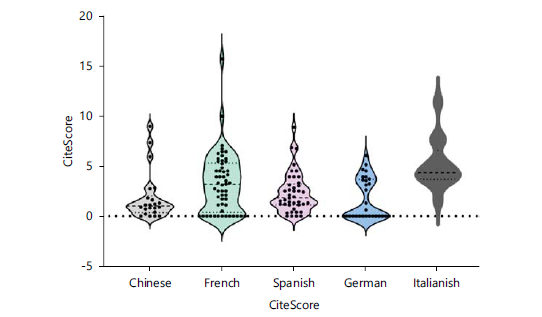
Analysis of PMC-indexed journals in different languages: The number of PMC-indexed journals in French, Spanish, German, and Italian is no more than 55 (54, 41, 29 and 14, respectively), and the distribution map of the CiteScore of non-English journals included in PMC is shown in Fig. 1.
As shown in Fig. 1, the number of French journals is the highest, and their CiteScore is evenly distributed within 1 to 5 and is higher than that of other language journals with the highest maximum of 15. The number of Chinese and German journals is the smallest, and their CiteScore is the lowest. The score of Chinese journals is mainly distributed around 1 while that of German journals is around 4 (Only half of the German journals have scores). Italian journals have the fewest low-scoring CiteScore journals, with a median CiteScore of 5, while the score of Spanish journals concentrated between 1 and 3.
CiteScore values represent journal citation impact (Scopus, 2024). The violin plot illustrates the distribution and density of CiteScore across different language groups. The width of each violin indicates the data density at a given value, while the central dashed line represents the median CiteScore. Individual data points correspond to specific journals. The dotted horizontal line at 0 indicates journals without available CiteScore (assigned as 0).
Analysis of current status of PMC-indexed non-english journals: It is shown from the data above that the number of non-English journals currently included in PMC is still relatively small and PMC mainly includes English journals. The reason is that the inclusion of non-English journals in PMC is based on MEDLINE’s inclusion results. In 2023, PMC opened up the inclusion of Spanish journals, but other non-English journals still need to apply for MEDLINE first.
From Fig. 1, it can be seen that among the non-English journals included in PMC, French and Italian journals have higher influence, while German journals have the lowest CiteScore and influence.
In summary, it is necessary for the non-English journals to enhance their influence and actively apply for MEDLINE before they can be included in PMC.
Strategy of the process of journal application, review and inclusion for MEDLINE and PMC: The application for MEDLINE and PMC is online and can be filled out and submitted on the database website. The review process and evaluation content of PMC are consistent with those of MEDLINE. A PMC accepts applications from any currently-indexed MEDLINE journal, regardless of the language of publication.
| Table 1: | Approval status of scientific quality review from MEDLINE | |||
| Fiscal year (Oct.1-Sep.30) | Evaluated | Passed scientific quality review |
| FY2024 | 269 | 37 |
| FY2023 | 286 | 31 |
| FY2022 | 238 | 34 |
| FY2021 | 350 | 44 |
| FY2020 | 416 | 50 |
Starting in February 2023, PMC also accepted applications from non-MEDLINE journals published in Spanish. The National Library of Medicine (NLM) noted on September 2025 that the Literature Selection Technical Review Committee (LSTRC), which was established in 1987 to review journals that had applied to MEDLINE, was terminated in 2025 and NLM is reviewing the journal selection processes. The review of journals can be summarized into the following stages, and applications may be rejected at any stage of the review process.
Initial application screening: This stage includes the review of basic information, various regulations, and editorial board information of the journal. Therefore, the journal’s website should have an English version displaying the above information. It should be noted that detailed introduction of editorial board information is required and its internationalization should be ensured.
Scientific quality review: This stage mainly reviews whether the articles meet international standards for paper editing and writing, and whether the information that should be disclosed has been clarified properly. In addition, the charts and other contents will be reviewed. Scientific quality review is the most important step in the application and evaluation process and also has strict standards (SEE Table 1).
Technical and indexing requirements check: This step mainly confirms the submission of articles’ XML files and when the files will be provided. As PMC is a full-text OA database and the application journals may be non-OA journals, it is necessary for these journals to clarify how long the articles can be open after the publication, such as 6, 12, or 24 months after publication.
Re-application: An interval of 24 months is required to do the re-application for PMC inclusion (as well as MEDLINE inclusion). During this period, journal’s editorial department should increase the proportion of articles, enhance the scientific nature of journal articles, strengthen the substantive quality and depth of the papers, and make adjustments according to the review feedback. If the journal failed to pass the second application, it is eligible to re-apply in 36 months. During the application period, PMC will communicate with the publisher, and if there is no timely response, the review may be suspended.
MAIN ISSUES TO BE NOTED DURING THE APPLICATION PROCESS FOR NON-ENGLISH JOURNALS
PMC accepts applications from any currently-indexed MEDLINE journal, irrespective of the language of publication. Chinese journals that have been included in MEDLINE can apply for inclusion in PMC easily. Since the inclusion of the Chinese Journal of Lung Cancer, MEDLINE has not included any new Chinese journals. When applying for MEDLINE and PMC, the following issues should be noted.
Detailed English information of the primary content: In addition to providing the English translation of the basic information of the articles, the main points of the articles should be presented through a detailed English abstract to increase the chances of being included in MEDLINE.
Detailed information of the editorial board: Each editorial board member, including honorary editors-in-chief, should have a detailed introduction.
Diversity of editorial team: Personnel should come from all over the world, and the main research direction of the editorial team should be consistent with the content of the journal.
Information on department editors should be displayed. The main responsibilities of department editors are to review and edit author manuscripts. After the author submits the manuscript, the department editor will submit it to the editorial board (or editor-in-chief) for scientific review, or be in charge of manuscript editing or even be responsible for the whole submission process of the manuscript. However, some scholars believe that department editors are the main responsible editors in a certain topic area, and can correspond to senior planning editors in practical work.
A detailed peer review process should be provided. There are some notices that need to be paid attention to. Peer review should adopt the single-blind method, and external peer review is conducted by at least two peer reviewers. The review guidelines should be listed in a prominent location on the journal’s website with detailed review requirements. Reviewers should pay attention to the ethical requirements of clinical research, and the research should obtain ethical approval (An explanation should be provided if there is no such requirement), and the name of the Ethics Committee or Institutional Review Board should be listed; the informed consent should be mentioned in the article. Clinical trials should be pre-registered, and the registration number should be listed in the abstract and main text.
However, in any case, the standards should be practiced at least one year before the journal application, so that the published articles comply with the best practices.
The recommended standards of the International Committee of Medical Journal Editors (ICMJE): The journal should disclose the ICMJE recommendation standards uniformly to all authors and give a detailed explanation of ICMJE standards on the website or in the submission guidelines, so that authors can provide detailed explanations of authorship, contributions, acknowledgments and other information when submitting.
KEY POINTS ANALYSIS OF NON-ENGLISH APPLICATION FOR MEDLINE OR PMC
As PMC does not accept non-English journals independently, they can only apply for MEDLINE first. After being included by MEDLINE, they can then apply for PMC and the judgments mainly are based on the results of MEDLINE’s review. The full texts of articles are required to be provided to PMC after acceptance. It should be noted that the journals must apply for PMC independently after MEDLINE’s acceptance because PMC does not actively include MEDLINE journals. Take the Journal of Clinical Otolaryngology and Head Neck Surgery (ISSN: 2096-7993) as an example. It was included in the PubMed Central database in 2023, but in-depth analysis revealed that the journal had already been included in MEDLINE in 2007.
Although PMC is a green OA database, whether the journal is an OA journal has no impact on the inclusion results. Therefore, non-OA journals included in PMC can adopt the delayed open access strategy. Previous research reports10 have indicated that it is advantageous for journals to be included in PMC if they are also listed in the Directory of Open Access Journals (DOAJ) database, which is the world’s largest OA database. Nevertheless, in accordance with the most recent review criteria, these two aspects are no longer pertinent, and no correlation exists in the data collection. PMC collects journals of gold OA, diamond OA, green OA, mixed-model publishing and subscription-based journals, among which mixed-model and subscription-based journals are required to open all the papers on the PMC website no later than 12 months. This is completely different from DOAJ, which exclusively encompasses OA journals, with OA types limited solely to gold OA and diamond OA11.
For newly established journals, the title of the journal should match the content of the report, with a higher proportion of original research papers, unless it is a review-type journal. As a start-up journal, it receives relatively few unsolicited submissions, while a substantial number of review papers are invited. Therefore, the low proportion of original research papers is an urgent issue that we need to address. It is suggested that newly established journals, especially English journals, could adopt the diamond OA journal model, with no article processing charges (APC)12, which is helpful in attracting research-oriented papers13. The journal is recommended to have a continuous publication for more than 12 months with a publication of no less than 40 peer-reviewed articles.
| Table 2: | Display of institutional content on the english website of the journal when applying for PMC | |||
| Contents and details | |||
| Policy | |||
| Policies on conflict of interest, human and animal rights, and informed consent |
Notify the author to disclose the corresponding content in the article, and there should be corresponding processes and approvals for animal ethics. If not, reasons should be explained |
||
| Data sharing policy | Details related to data sharing in clinical and basic research | ||
| Editorial policies | Responsibilities of editorial board editors and scope of work for section editors |
||
| Peer review policy | It should be clarified whether peer review is single blind or double-blind, and the specific details of the peer review process |
||
| Advertising policy | If there are no requirements or investment rules for advertising, they may not be displayed |
||
| Research ethics policy | The article should explain the source and batch number of the ethical approval documents, and if not, provide reasons |
||
| Informed consent policy | The article should elaborate on the content of the informed consent form, and if not, provide reasons |
||
| The process for handling cases requiring corrections, retractions, and editorial expressions of concern |
Information on errata, correction, and retraction | ||
REQUIREMENT FOR JOURNAL’S WEBSITE
When filling out the MEDLINE online application form, the corresponding valid website (URL) for each system of the journal should be filled in, which helps MEDLINE or PMC to review relevant information through the journal website. In addition to the basic information about the journal that are included in the application tables, the journal’s website should also display various regulations and detailed content in English version online, including editorial regulation, peer review system, advertising system, research ethics statement, informed consent statement, etc.14,15. Therefore, before submitting an application, journals should check their website in case of any missing information needed. The main content that needs to be displayed on the English website when applying for PMC for a journal, is shown in Table 29.
REQUIREMENT FOR EDITORIAL BOARD AND PEER REVIEW SYSTEM
MEDLINE and PMC require journals to have an international editorial team with diverse regional sources. Therefore, Chinese journals applying for MEDLINE face the problem that most of the editorial board members are Chinese. The full names, qualifications, affiliated institutions, and personal introductions (photos can be attached) of the editorial committee members, whether they have corresponding academic qualifications in their professional fields, whether the roles of the editorial committee members are clear, and whether the journal system supports transparency, repeatability, open science, and data sharing are also assessment criteria.
The content of the peer review system should include whether the peer review process is clear and sufficiently detailed, including information on the types of peer reviews and the number of reviewers typically assigned to manuscripts, whether the journal has a system for reviewing articles written by editors and editorial committee members, the ethical standards of the journal, author conflict of interest statements and disclosure of research funding sources, and whether commercial funding is involved.
In summary, when the PMC reviews the application of journals, it focuses on the construction of information transparency on journal websites, according to the “Principles of Transparency and Best Practice in Scholarly Publishing”. This guideline, developed in collaboration with four academic organizations, the Committee on Publication Ethics (COPE), Directory of Open Access Journals (DOAJ), Open Access Scholarly Publishing Association (OASPA), and World Association of Medical Editors (WAME),
was first adopted by DOAJ in December 2013 and has since been updated to version 416. By implementing the “Principles of Transparency and Best Practice in Scholarly Publishing” during the review process, PMC can bolster the transparency of the information and refine its institutional setup on its journal websites.
EVALUATION REQUIREMENT FOR THE ARTICLES
The scientific quality review of articles is of paramount importance in the evaluation work of MEDLINE and PMC with a rigorous, comprehensive, and multi-step process. At present, MEDLINE and PMC follow their newly established “Scientific and Editorial Quality Assessment Principles” for the literature evaluation.
The assessment evaluates the quality of journal articles from the following five aspects:
| • | Scope and coverage of the manuscript, editorial policies and processes, scientific rigor of article content, production and administration, and impact | |
| • | Some of the aspects of the evaluation overlap with the initial application review, such as the scope of submission, diversity of the editorial board, and editing strategies and processes | |
| • | Each stage is assessed by two review experts and they will provide the results with 4 levels, outstanding, good, fair, and poor | |
| • | MEDLINE and PMC will give an inclusion recommendation after integrating the results from different aspects |
Among these 5 aspects, the editorial policies and processes, as well as the scientific rigor of article content, are the main focus. In the process of writing and editing articles, the journals should strictly adhere to Best Practice, which is also the same requirement for databases such as DOAJ15. The Best Practice refers to the guidelines and standards that the articles published in a journal should adhere to, in order to ensure the standardization of scientific writing and the authority of their methodology. Journals should indicate relevant writing requirements and standards on their websites and strictly adhere to them in practice. The writing and editing strategies for different types of articles follow different international guidelines, and currently there are a total of 50 writing guidelines listed in the MEDLINE Resources Guide17,18. For more guidance, MEDLINE suggests to refer to the “Library for Health Research Reports” published by the Equator Network (Enhancing the Quality and Transparency of health Research, EQUATOR)19.
The evaluation for scientific rigor of article content mainly aims at research-oriented papers. There are two key points for the review in regards of this aspect: Whether the abstract fully and accurately describes the content of the article with a structured format. Whether the research purpose is clear and logical. Whether the research methods are correct and the steps are elaborated in detail, so that the experiment can be repeated according to the description; whether the research design is robust and suitable for the stated objectives; whether the results obtained are supported by corresponding experimental and statistical data, and whether the statistical methods are correct is also one of the evaluation indicators. Whether the discussion section is detailed and comprehensive. The number of references and the proportion of new literature (published within the past 2 years), and whether they support the conclusions of this article.
The problem that new journals often face is that there are fewer naturally submitted articles, while most of the commissioned articles are review articles and there are fewer research-oriented works. Therefore, before applying for inclusion in MEDLINE or PMC, biomedical journals should ensure that journals published within the previous 2 years have a high proportion of research papers, in order to reflect the scientific nature of the journal. In addition, attention should be paid to the use of research methods and statistical methods, as well as the correctness of result judgment.
IMPROVEMENT OF JOURNAL PUBLISHING QUALITY AND COMPREHENSIVE IMPACT
Regarding the evaluation of journal impact, MEDLINE examines the overall positioning of the journal and the main purpose of the journal’s publication (which is reflected on the journal website), and whether the articles it publishes conform to the positioning and the status in the field.
As for Chinese journals, the diversity of authors and editorial board members needs to be enhanced, as well as the proportion of research-oriented articles, which have a higher impact than reviews. In addition, as MEDLINE mainly reviews the application through English content, disclosing detailed long abstracts is beneficial for MEDLINE’s review and inclusion.
In summary, sufficient preparation should be made in all aspects before applying for inclusion. Since the scientific quality of articles is the cornerstone of journal publication, the applied journal should do a good job in soliciting and inviting submissions to ensure the proportion of research-oriented papers and the quality of the papers.
Journals that have failed for the first time should make improvements strictly according to the feedback from the review report, which is the only way to help them apply for MEDLINE or PMC inclusion successfully the next time. By strictly adhering to the following work contents, the journal should establish a two-year objective aimed at comprehensive enhancement, thereby laying the groundwork for its re-submission for inclusion in MEDLINE and PMC: The editorial department should intensify efforts in soliciting manuscripts, understand the cutting-edge research frontiers and conduct interviews and invite submissions with experts. Ensure the internationalization of manuscript sources. In addition, efforts are being made to internationalize the editorial boards, and institutional support is also provided for manuscript sources. Relying on the advantages of supervisors and organizers, various assistance is provided to the journal. Thirdly, strictly follow the standards of MEDLINE and PMC’s Scientific and Editorial Quality Assessment, standardize the writing and editing practices of international journals, apply relevant guidelines for international paper writing and editing in practice, guide authors in writing, strengthen paper review, and deepen the connotation construction of journals. Finally, strictly abide by and fulfill the various regulations of the journal, and use the regulations to guide specific work.
CONCLUSION
Being included in important international databases is one of the important ways to achieve internationalization of journals. At present, the number of non-English journals included in MEDLINE and PMC is still relatively small, and the inclusion requirements are increasing day by day. The scientific quality evaluation system of MEDLINE and PMC helps to enhance the connotation quality and scientificity of journals. Journals applying for MEDLINE and PMC should strictly regulate their paper writing in accordance with Equator Network’s “Guidelines for Biomedical Research Reports” to improve the connotation quality of journals; Secondly, the editorial department of the journal should increase its efforts to draft manuscripts, actively expand international editorial boards, and use editorial boards to drive the diversity of manuscript sources, thereby improving the quantity and quality of manuscript sources; Again, actively apply for more databases (such as DOAJ, Scopus, etc.) to expand the international influence of the journal. In summary, this article elaborates on the key points and latest standards for applying for inclusion in MEDLINE and PMC databases, aiming to provide a reference for other biomedical journals in China to apply for MEDLINE and PMC databases.
SIGNIFICANCE STATEMENT
This study provides practical guidance for non-English biomedical journals seeking inclusion in MEDLINE and PMC by outlining updated evaluation criteria, challenges, and strategies. It highlights the importance of scientific quality, editorial transparency, and internationalization, offering a structured roadmap to enhance global visibility, improve publishing standards, and strengthen the international impact of regional journals.
REFERENCES
- Ren, S. and R. Rousseau, 2002. International visibility of Chinese scientific journals. Scientometrics, 53: 389-405.
- Zhang, S. and M. Zeng, 2022. Strategies for Chinese academic journals of humanities and social sciences to go out: Based on Scopus. Chin. J. Sci. Tech. Periodicals, 33: 661-669.
- PubMed, 2025. About PubMed. .
- Xia, X.Y., L.J. Pan, Y.F. Huang and X.J. Shang, 2007. Entering into MEDLINE database: Important way for internationalization of medical journals. Chin. J. Sci. Tech. Periodicals, 18: 306-308.
- Gasparyan, A.Y., L. Ayvazyan, H. Blackmore and G.D. Kitas, 2011. Writing a narrative biomedical review: Considerations for authors, peer reviewers, and editors. Rheumatol. Int., 31: 1409-1417.
- National Library of Medicine, 2025. MEDLINE application and evaluation process.
- PMC, 2023. PMC International.
- Wang, L.H., G.T. Li and M. Ni,. 2023. Strategy analysis of Chinese biomedical journals applying for international databases: Taking China Oncology as an example. Chin. J. Sci. Tech. Periodicals, 34: 1636-1644.
- Hu, X., 2024. Development status and analysis of English medical journals in China oriented to world first-class scientific journals. Chin. J. Sci. Tech. Periodicals, 35: 532-540.
- Xue, J., H. Shu, H. Li, W. Li and X. Tian, 2013. The stability of literacy-related cognitive contributions to Chinese character naming and reading fluency. J. Psycholinguistic Res., 42: 433-450.
- Peng, D., J. Huang, F. Wang, X. Rui and X. Liu, 2025. Monitoring of global OA journals and article processing charges in 2024 and suggestions for China’s response strategies. Chin. J. Sci. Tech. Periodicals, 36: 1445-1453.
- Wang, L., M. Ni and X. Li, 2025. The development status and countermeasures of biomedical OA journals in China: A study based on statistical analysis of the journal indexed data in PubMed Central and DOAJ. J. Scholarly Commun., 1.
- Liu, J., 2025. Open access publishing in Singapore: Trends and policy perspectives. J. Scholarly Commun., 1.
- National Library of Medicine, 2026. MEDLINE policies.
- National Library of Medicine, 2024. NIH data sharing policies.
- DOAJ, 2025. Transparency & best practice.
- National Library of Medicine, 2025. Journal selection for MEDLINE.
- National Library of Medicine, 2025. Research reporting guidelines and initiatives: By organization.
- EQUATOR, 2025. Reporting guidelines for main study types.
How to Cite this paper?
APA-7 Style
Li,
X. (2026). Research on the Latest Progress and Strategies of Non-English Journals Included in PubMed. Trends in Scholarly Publishing, 5(1), 55-63. https://doi.org/10.21124/tsp.2026.55.63
ACS Style
Li,
X. Research on the Latest Progress and Strategies of Non-English Journals Included in PubMed. Trends Schol. Pub 2026, 5, 55-63. https://doi.org/10.21124/tsp.2026.55.63
AMA Style
Li
X. Research on the Latest Progress and Strategies of Non-English Journals Included in PubMed. Trends in Scholarly Publishing. 2026; 5(1): 55-63. https://doi.org/10.21124/tsp.2026.55.63
Chicago/Turabian Style
Li, Xiaowen.
2026. "Research on the Latest Progress and Strategies of Non-English Journals Included in PubMed" Trends in Scholarly Publishing 5, no. 1: 55-63. https://doi.org/10.21124/tsp.2026.55.63

This work is licensed under a Creative Commons Attribution 4.0 International License.