
Paper Mills: Industrialised Fraud and the Erosion of Trust in Science
-
Fatemeh Nourmohammadi

Molecular Medicine Research Center, Hormozgan Health Institute, Hormozgan University of Medical Sciences, Bandar Abbas, Iran
Muhammad Sarwar
Asian Council of Science Editors, United Arab Emirates
| Received 07 Mar, 2026 |
Accepted 03 Aug, 2026 |
Published 09 Sep, 2026 |
Paper mills are commercial entities that fabricate and sell academic manuscripts and are increasingly recognised as a major challenge to research integrity in contemporary scholarship. Unlike isolated misconduct, paper mills industrialise fraud by generating large volumes of fabricated or manipulated manuscripts, often accompanied by falsified data, images, and author affiliations. This practice affects the credibility of scientific communication, introduces unreliable material into the scholarly record, and may weaken public trust. The objectives of this review are to map the typologies and workflows of paper mills, analyse case studies across diverse scientific disciplines, assess their measurable impacts on citations, research policy, and societal trust, and identify gaps in current detection and prevention strategies. A narrative review methodology was employed, drawing on peer-reviewed literature published between 2018 and 2025 from PubMed, Scopus, Web of Science, Google Scholar, and relevant editorial platforms. Search terms included paper mill fraud, publication manipulation, fake peer review, and retracted papers. Grey literature, policy documents, and investigative reports were also considered for insights into typologies, workflows, case evidence, and institutional responses. The review identified recurring workflows such as template-based manuscript generation, image and data recycling, falsified peer review, and exploitation of special issues. Case studies illustrated contamination across life sciences, clinical medicine, and engineering, with thousands of articles retracted through large-scale publisher investigations. Quantitative analyses documented the rapid growth of paper mill outputs, persistent citation of retracted articles, and distortion of bibliometric indicators, amplifying their influence on scholarly communication. Paper mills represent an industrialised form of academic fraud with systemic implications for scholarly communication and research evaluation. This review synthesizes current evidence on their typologies, workflows, disciplinary spread, and measurable effects on citations, academic evaluation, and trust in science.
| Copyright © 2026 Nourmohammadi and Sarwar. This is an open-access article distributed under the Creative Commons Attribution License, which permits unrestricted use, distribution, and reproduction in any medium, provided the original work is properly cited. |
INTRODUCTION
Scientific progress relies on trust, trust that the research is conducted rigorously, reported honestly, and peer-reviewed thoroughly. Yet that foundation has been significantly shaken by the rise of for-profit paper mill entities that fabricate and sell academic manuscripts, complete with manipulated data, fake images, and authorship guarantees. Unlike typical cases of individual misconduct, paper mills industrialise fraud, churning out large volumes of deceptive manuscripts that infiltrate diverse fields and geographical regions. This represents a systemic challenge to the integrity of the scholarly record and the credibility of scientific communication. The Committee on Publication Ethics (COPE) defines paper mills as unethical organisations that “Produce manuscripts for profit, often by fabricating data and images, and selling authorship1”. These differ substantially from ghost-writing; paper mills manufacture falsified or plagiarized content designed to deceive reviewers and editors, and often include fabricated datasets and manipulated images2. Some investigations have even traced large-scale operations, documenting how networks of hundreds of staff produce manuscripts on demand for sale. These manuscripts often come with “authorship slots” that buyers can purchase to boost their academic standing3,4. Recent high-profile publisher interventions underscore the scale of the problem. In 2024, over 11,300 papers were retracted due to paper mill activity, prompting the closure of multiple journals and sparking editorial reforms5. This pattern may be understood as part of a broader expansion of fraudulent research associated with publication pressure and “publish or perish” culture6. Roughly 2% of all scientific articles in 2022 exhibited patterns suggestive of paper mill generation7. Additional estimates suggest that a substantial number of such papers may already be present in the published literature8. Notably, a provenance-based image was developed of an analysis methodology that clusters papers likely generated by the same mill by tracking duplicated or manipulated figures across manuscripts9. This scalable technique offers a promising approach to flag systematic fraud. A cross-sectional study examined the occurrence and citation patterns of retracted papers from mills, documenting how those papers continued to be cited, even after retraction, impacting citation integrity10. Paper mills don’t stop at content fabrication; they also manipulate the peer-review process. An analysis of reviewer comments revealed that some mills create fake reviewer accounts to submit canned or duplicated peer-review reports, a practice detectable through duplication analysis11.
In some cases, compromised guest editors or hijacked editorial systems allow fraudulent studies to bypass review checks, particularly in special issues or journals with weak oversight. Investigations have documented patterns of authorship manipulation, including the international sale of co-authorship positions and the commercialisation of manuscript production services. Such practices raise concerns about the credibility of international research networks. While, academic misconduct has a long history, the current crisis is distinguished by its industrialisation. Fraud has shifted from isolated individuals to organised enterprises that exploit globalised academic economies, effectively commercialising deceit12.
The pressures driving demand are equally important. In many regions, hiring and promotion policies equate publication numbers with professional advancement. In China, until recent reforms, researchers received financial bonuses for indexed publications, a policy that encouraged paper mill proliferation. Similar dynamics in India, Russia, and parts of Eastern Europe sustain the demand for fraudulent services. At the same time, journals face criticism for prioritising volume over quality, launching special issues at unprecedented rates, and leaving vulnerabilities for exploitation. Thus, paper mills are not simply external infiltrators but symptoms of deeper structural weaknesses in academia’s incentive and publishing systems.
Paper mills have proliferated due to the convergence of several systemic factors within the academic publishing ecosystem. The widespread "publish-or-perish" culture places significant pressure on researchers to publish for career advancement, promotion, and research funding, thereby increasing the demand for rapid publication services. At the same time, weaknesses in editorial oversight and peer-review processes, particularly in some open-access and special-issue publishing models, create opportunities for manipulation and fraudulent practices. Economic incentives further encourage unethical actors, as producing fabricated manuscripts can be more profitable than maintaining rigorous editorial standards, effectively transforming scholarly metrics into marketable commodities. Moreover, the unprecedented growth in manuscript submissions has overwhelmed many journals, making comprehensive screening increasingly challenging and allowing low-quality or fraudulent studies to evade detection and enter the scientific literature12.
The objective of this review is to provide a comprehensive understanding of paper mills by mapping their typologies and workflows, analysing case studies across disciplines, evaluating their impacts on citations, policy, and trust, and identifying gaps in current detection and prevention approaches.
MATERIALS AND METHODS
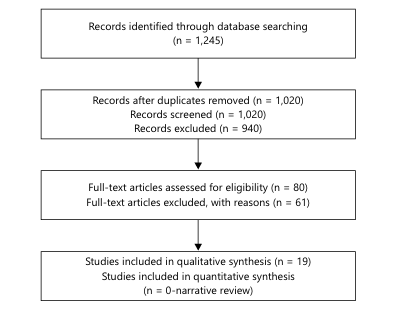
This review employed a narrative synthesis methodology with systematic elements to capture the breadth of literature addressing paper mills, industrialised fraud, and their impacts on science. The process consisted of three primary stages: Database searching, eligibility screening, and thematic analysis. Peer-reviewed literature was retrieved from Scopus, PubMed, Web of Science, and Google Scholar. Additional policy and editorial documents were identified through the Committee on Publication Ethics (COPE) website and publisher press releases. Search strings combined keywords and Boolean operators: “Paper mill” or “Publication fraud” or “Manuscript manipulation” or “Fabricated research” or “Fake peer review”. To capture disciplinary variation, secondary terms such as “Biomedical journals”, “Engineering retractions”, and “Special issues exploitation” were also applied. The search window was restricted to publications between 2018 and 2025, reflecting the period during which paper mills have been most systematically documented. Grey literature, including investigative journalism, editorial statements, and institutional reports, was used for contextual background and illustration of emerging patterns, but was not treated as primary evidentiary support for the main synthesis (Fig. 1).
Inclusion criteria: Sources were included if they:
| • | Explicitly discussed paper mills or organized fraudulent authorship services | |
| • | Analysed workflows or typologies of fraudulent production | |
| • | Documented retraction cases or publisher-level interventions | |
| • | Assessed the impact of fraudulent papers on citations, policy, or public trust |
Exclusion criteria: Excluded were papers that solely addressed plagiarism, isolated misconduct, or predatory journals without specific reference to industrialised paper mill activity.
|
Relevant studies were imported into Zotero for reference management and coded using thematic analysis. Codes included “typologies and workflows”, “disciplinary case studies”, “impact on citations/metrics”, “policy and editorial responses”, and “public trust”. Special attention was paid to high-profile case studies (e.g., Wiley-Hindawi mass retractions) and methodological innovations in detection (e.g., provenance-based image analysis). While randomized or experimental evidence is absent due to the nature of the subject, included sources were appraised based on transparency of methodology, presence of verifiable data (e.g., retraction counts, citation analyses), and credibility of the publishing outlet. Non-peer-reviewed sources were used only to contextualise patterns, not to draw primary conclusions. This approach is broad enough to account for the evolving and covert nature of paper mills.
RESULTS AND DISCUSSION
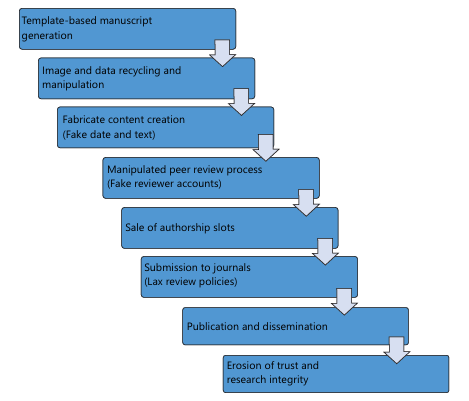
Typologies and workflows: Paper mills exhibit remarkable adaptability, evolving in line with publishing trends. Typologies distinguish between “manuscript factories” that produce fabricated articles and “authorship brokers” who sell co-authorship on pre-written manuscripts. Other categories include image-recycling mills and peer-review manipulation mills that fabricate reviewer identities. Common workflows involve template-based text reuse, data fabrication or image manipulation, authorship sales with pricing linked to journal impact, exploitation of special issues, and fraudulent peer review. Forensic tools, such as image provenance analysis and linguistic stylometry, have provided empirical evidence of these practices. The following flowchart illustrates the typical industrialized workflow of paper mills in academic publishing (Fig. 2).
Figure 2 shows a schematic overview of commonly reported paper mill workflows, including manuscript templating, data or image manipulation, authorship sales, peer-review interference, and journal submission pathways.
|
|
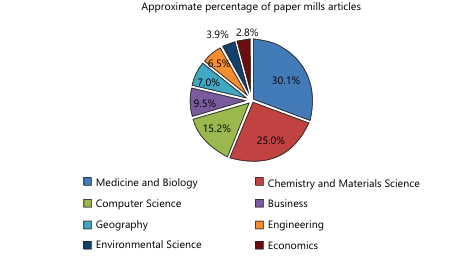
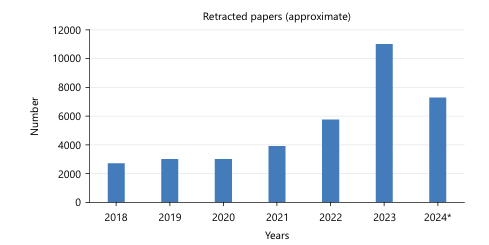
Case studies across disciplines: Biomedical sciences remain the most heavily affected. For example, over 300 cancer biology papers indexed in PubMed displayed hallmarks of paper mill production. Neuroscience and anesthesiology journals have also been infiltrated, with fraudulent trials contaminating meta-analyses. Beyond medicine, engineering and computer science have seen large-scale infiltration, including 1,700 fraudulent conference papers identified by Springer Nature. In social sciences, fabricated survey data have been sold to authors in education and management (Fig. 3). A landmark case involved Wiley’s Hindawi imprint, which retracted more than 11,300 papers between 2022 and 2024 due to systematic exploitation of special issues (Fig. 4).
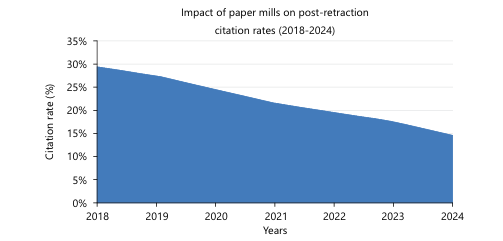
Impacts on citations, policy, and trust: Retracted papers continue to accumulate citations, with oncology papers averaging 11 citations before retraction and nearly 40% cited afterward. Citation contamination distorts bibliometrics, institutional rankings, and funding decisions. During the COVID-19 pandemic, fraudulent studies infiltrated policy discussions before retraction, directly influencing decision-making. At a broader level, mass retractions have eroded public trust in science, raising concerns about the reliability of peer review (Fig. 5).
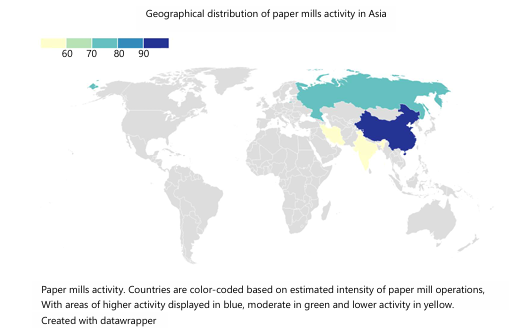
Global perspectives: Paper mills flourish where academic pressure and weak enforcement converge. China remains a hotspot due to publication-based incentives, though similar markets are emerging in India, Russia, Iran, and Eastern Europe (Fig. 6). Western publishers have deployed integrity teams and forensic tools, but responses remain inconsistent. A lack of a global registry for suspicious submissions enables fraudulent manuscripts rejected in one journal to resurface elsewhere.
|
|
Paper mills represent more than isolated misconduct; they reflect a systemic rupture in the academic ecosystem. They affect the scholarly record by introducing unreliable findings that may persist through post-retraction citation, alter academic incentives through purchased authorship, and place pressure on conventional peer-review mechanisms. Their influence extends beyond academia into policy and clinical practice, where fraudulent findings risk informing decisions with real-world consequences19-21.
Forensic scientometrics has emerged as a promising approach, blending bibliometrics and forensic analysis to detect anomalies in text, data, and images22. However, these tools must be accompanied by cultural reforms that prioritize rigor and reproducibility over publication volume, collaborative intelligence-sharing across publishers and institutions, and enforceable ethical frameworks that extend to editors and reviewers. Education is also vital, equipping researchers with the awareness to recognize and resist paper mill offers23.
The crisis also exposes structural contradictions in publishing. Article processing charges create perverse incentives for publishers to prioritize volume over integrity. Special issues and weak editorial vetting provide opportunities for exploitation. These observations suggest that detection strategies alone may be insufficient if structural incentives within publishing remain unchanged24.
Ultimately, paper mills embody an epistemic threat, reshaping what is accepted as “known” in science. By normalizing shortcuts, they risk eroding the professional ethos of research and public trust in evidence-based decision-making. Combating them requires systemic reforms that recommit academia to truth, rigor, and accountability.
LIMITATIONS AND GAPS
This review has several limitations. First, definitions of “paper mill” vary across studies, complicating comparisons and prevalence estimates. Second, available data are biased toward retracted articles and publisher investigations, which likely represent only the visible fraction of misconduct. Many suspected papers remain undetected, creating a “dark figure” of hidden fraud. Third, detection has been concentrated in biomedical sciences, leaving infiltration in social sciences and regional journals underexplored. Fourth, existing forensic methods, such as image analysis and stylometry, are imperfect, sometimes generating false positives or missing sophisticated forgeries. Finally, reliance on publisher disclosures introduces conflicts of interest, as integrity breaches may not always be reported transparently. These gaps highlight the need for more consistent definitions, broader disciplinary mapping, improved detection technologies, and independent oversight.
CONCLUSION
Paper mills represent an industrialized form of academic fraud with profound implications for science and society. By fabricating data, manipulating peer review, and exploiting systemic weaknesses in publishing, they distort the scholarly record, undermine trust in research, and threaten the credibility of evidence-based decision-making. Addressing this crisis requires coordinated global efforts that integrate technological detection, cultural and institutional reform, and stronger ethical enforcement. Only through systemic change can the integrity of scholarly communication be preserved.
SIGNIFICANCE STATEMENT
This review demonstrates that paper mills are not isolated cases of misconduct but an organised industry reshaping the academic landscape. Their infiltration across disciplines and countries shows that no field is immune. By highlighting typologies, workflows, case studies, and measurable impacts, this study provides an analytical framework for understanding how these practices affect research reliability, academic evaluation, and public trust in science.
REFERENCES
- Else, H. and R. van Noorden, 2021. The fight against fake-paper factories that churn out sham science. Nature, 591: 516-519.
- Christopher, J., 2021. The raw truth about paper mills. FEBS Lett., 595: 1751-1757.
- Abalkina, A., 2024. Commercialization of scientific misconduct: The challenge of paper mills. Eur. J. Public Health, 34: iii265-iii265.
- Abalkina, A., 2023. Publication and collaboration anomalies in academic papers originating from a paper mill: Evidence from a Russia‐based paper mill. Learned Publ., 36: 689-702.
- Subbaraman, N., 2025. Scientific journals can’t keep up with flood of fake papers. Wall Street J.
- Candal-Pedreira, C., J.S. Ross, A. Ruano-Ravina, D.S. Egilman, E. Fernández and M. Pérez-Ríos, 2022. Retracted papers originating from paper mills: Cross sectional study. BMJ, 379.
- Byrne, J.A. and J. Christopher, 2020. Digital magic, or the dark arts of the 21st century-how can journals and peer reviewers detect manuscripts and publications from paper mills? FEBS Lett., 594: 583-589.
- Wykes, T. and A. Parkinson, 2023. The anxiety of the lone editor: Fraud, paper mills and the protection of the scientific record. J. Mental Health, 32: 865-868.
- Cardenuto, J.P., D. Moreira and A. Rocha, 2024. Unveiling scientific articles from paper mills with provenance analysis. PLoS ONE, 19.
- Tang, G. and H. Cai, 2025. Citation contamination by paper mill articles in systematic reviews of the life sciences. JAMA Netw. Open, 8.
- Horbach, S.P.J.M. and W. Halffman, 2018. The changing forms and expectations of peer review. Res. Integr. Peer Rev., 3.
- Fanelli, D., 2010. Do pressures to publish increase scientists' bias? An empirical support from US States data. PLoS ONE, 5.
- Parker, L., S. Boughton, L. Bero and J.A. Byrne, 2024. Paper mill challenges: Past, present, and future. J. Clin. Epidemiol., 176.
- Nagarkar, S. 2024. “Research paper mills”: A factory outlet for dubious research. Indian J. Med. Ethics, 9: 222-227.
- Fontaíña, N.M., C. Candal-Pedreira, G. García, J.S. Ross, A. Ruano-Ravina and L. Martin-Gisbert, 2025. Identifying common patterns in journals that retracted papers from paper mills: A cross-sectional study. Res. Integr. Peer Rev., 10.
- van Noorden, R., 2023. How big is science’s fake-paper problem? Nature, 623: 466-467.
- van Noorden, R., 2023. More than 10,000 research papers were retracted in 2023-a new record. Nature, 624: 479-481.
- da Silva, J.A.T., K. Santos-d'Amorim, and H. Bornemann-Cimenti, 2025. The citation of retracted papers and impact on the integrity of the scientific biomedical literature. Learned Publ., 38.
- Pérez-Neri, I., C. Pineda and H. Sandoval, 2022. Threats to scholarly research integrity arising from paper mills: A rapid scoping review. Clin. Rheumatol., 41: 2241-2248.
- Scholarly World, 2024. How are paper mills affecting science and scholarship? An analysis. Scholarly World.
- Kendall, G., 2025. The threat of paper mills. Ethical Publ.
- da Silva, J.A.T., 2021. Paper mills and on-demand publishing: Risks to the integrity of journal indexing and metrics. Med. J. Armed Forces India, 77: 119-120.
- Kalra, G., 2024. Paper mills and pseudoscience: Undermining research credibility. J. South Asian Assoc. Pediatr. Dent., 7: 123-124.
- McGrath, J.A. and S. Ahmed, 2024. Paper mill-backed writers: Here, there and everywhere? Br. J. Dermatol., 191: 151-152.
How to Cite this paper?
APA-7 Style
Nourmohammadi,
F., Sarwar,
M. (2026). Paper Mills: Industrialised Fraud and the Erosion of Trust in Science. Trends in Scholarly Publishing, 5(1), 138-145. https://doi.org/10.21124/tsp.2026.138.145
ACS Style
Nourmohammadi,
F.; Sarwar,
M. Paper Mills: Industrialised Fraud and the Erosion of Trust in Science. Trends Schol. Pub 2026, 5, 138-145. https://doi.org/10.21124/tsp.2026.138.145
AMA Style
Nourmohammadi
F, Sarwar
M. Paper Mills: Industrialised Fraud and the Erosion of Trust in Science. Trends in Scholarly Publishing. 2026; 5(1): 138-145. https://doi.org/10.21124/tsp.2026.138.145
Chicago/Turabian Style
Nourmohammadi, Fatemeh, and Muhammad Sarwar.
2026. "Paper Mills: Industrialised Fraud and the Erosion of Trust in Science" Trends in Scholarly Publishing 5, no. 1: 138-145. https://doi.org/10.21124/tsp.2026.138.145

This work is licensed under a Creative Commons Attribution 4.0 International License.